

SaaS Pricing Strategy for the US Market
August 15, 2025

Demand Generation for European SaaS Companies Expanding to the US
The first mistake isn’t picking the wrong channel. It’s trying to validate US demand using the same lead-generation engine that already works in Europe.
Why Your European Channels Don’t Transfer Directly
A cold outreach sequence that converts in Germany can fail in the US without the product having anything to do with it. The most commonly cited reason among agencies operating on both sides of the Atlantic is intent-data coverage: the third-party behavioral signals that flag “in-market” accounts run far deeper in the US than in European markets, where regulatory and linguistic fragmentation leaves gaps no database fully closes.
That has a practical consequence: a program that leans on intent data to prioritize accounts in Europe can lean on that same signal with much more confidence in the US — but only if the underlying data source was built for the US market, not adapted from your European stack.
The second difference is one of opportunity size:

The gap isn’t just volume — it’s the reason building a US-specific demand engine is worth the investment, rather than simply pushing more budget into the same European channel.
The Channel Mix That Works for a First US Push
There’s no universally “correct” channel — there’s a sequence that reduces the risk of burning validation budget on the wrong one first.
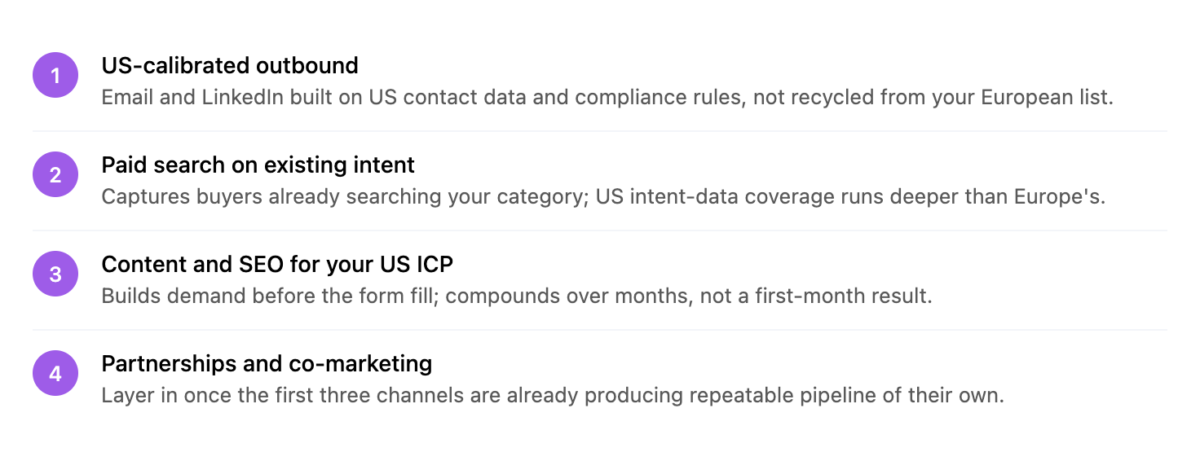
Specialists in US B2B lead generation tend to recommend building one predictable primary channel — typically outbound — before layering in LinkedIn, optimized content, and strategic partnerships. The logic is about learning: one channel executed well gives you clean signal on message and ICP; three channels run at once on a thin budget only gives you noise. Paid search fits right after, because it captures demand that already exists. Content and SEO build demand that doesn’t exist yet, but take longer to mature:
What to Build Before You Hire Your First US Salesperson
This is, by a wide margin, where European teams get the sequence wrong most often. They hire a US VP of Sales before they have evidence that demand is real — then discover the problem was never execution.
A useful distinction, borrowed from the mirror-image problem of opening Europe for US SaaS companies, is demand evidence versus demand noise:
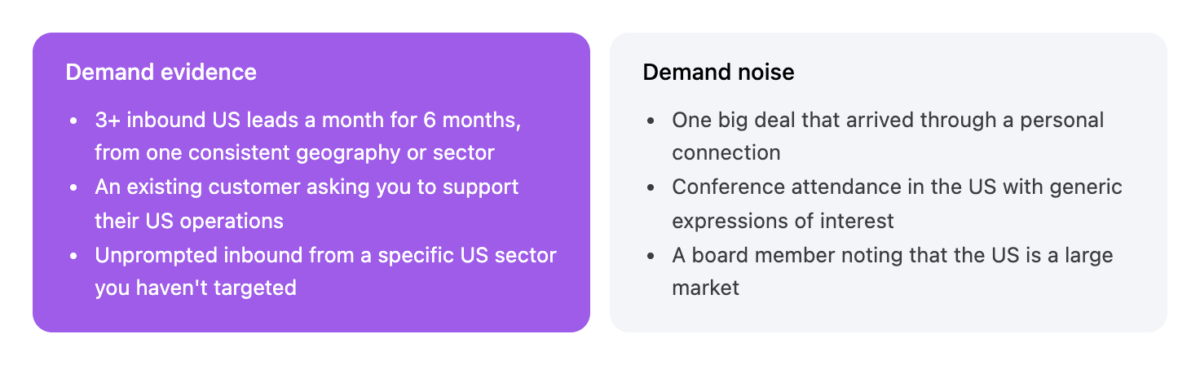
Evidence is repeatable and measurable. Noise feels just as exciting but predicts nothing.
The discipline isn’t waiting without acting — it’s spending demand-generation budget, not headcount budget, until the evidence is clear. Six months confirming real demand isn’t a delay. It’s the cheapest way not to make a bad hire.
Agency vs. In-House: When Each Makes Sense
The decision depends less on budget and more on how committed you already are to the market. While you’re still validating whether the US deserves a serious bet, a specialized outside partner reduces risk and avoids building infrastructure for demand that isn’t confirmed yet. Once you have proven traction and the market stops being an experiment, building in-house gives you tighter message control and better long-term unit economics — especially if your internal team already has the bandwidth and isn’t stretched thin on Europe.
A practical tell: if your marketing team is already maxed out on Europe, a parallel outside partner lets you run US validation without stealing focus from what already works.
The Europe-to-US Delta in Demand Generation
What actually changes isn’t just the channel — it’s the response speed buyers expect. US buyers evaluate and move in hours, not days, and an outreach sequence calibrated for a European decision cycle, where trust-building takes longer, can read as slow or irrelevant in the US. Intent-data coverage, as noted above, also favors the US buyer — there’s more signal available, but only if your data stack is built to read it.
None of this replaces product validation. But mistaking one-off enthusiasm for repeatable demand is, consistently, the most expensive mistake to unwind after you’ve already hired against it. Building a reliable US case for that traction is part of the same problem: how European SaaS companies build US case studies without a marquee logo walks through the sequence once your first channel starts producing real leads, and setting up CRM and pipeline tracking before you scale spend is what turns that early signal into something you can actually measure. If you want a working example of how this fits into a full market-entry sequence, our market entry framework covers it end to end.
Written by Luca Lundgren, Founder at Demand Scalers. Luca has five years of demand generation experience working with companies like Simplex Wireless and Dentsu, and holds a Master’s in Marketing from Aalto University.