

SOC 2 for European SaaS Companies Selling to US Enterprise Buyers
September 15, 2025
Demand Generation KPIs for Measuring US Market Entry
November 15, 2025

Positioning and Messaging for European SaaS Entering the US Market
Your homepage reads fine in English. It still doesn’t read like it was written for the person about to buy.
Why “It Worked in Berlin” Doesn’t Mean It Works in Boston
A lot of European B2B copy opens by setting the scene: the problem’s history, the market context, the philosophy behind the approach, and only then the point. That structure builds credibility with a European reader who expects thoroughness before commitment. A US buyer scanning the same page in the first eight seconds reads it as stalling — three paragraphs before the payoff, and they’ve already opened the next tab.
The fix isn’t to strip out substance. It’s to reorder it: state the outcome first, then let the context follow for the reader who wants it.
Below is the same message written both ways.
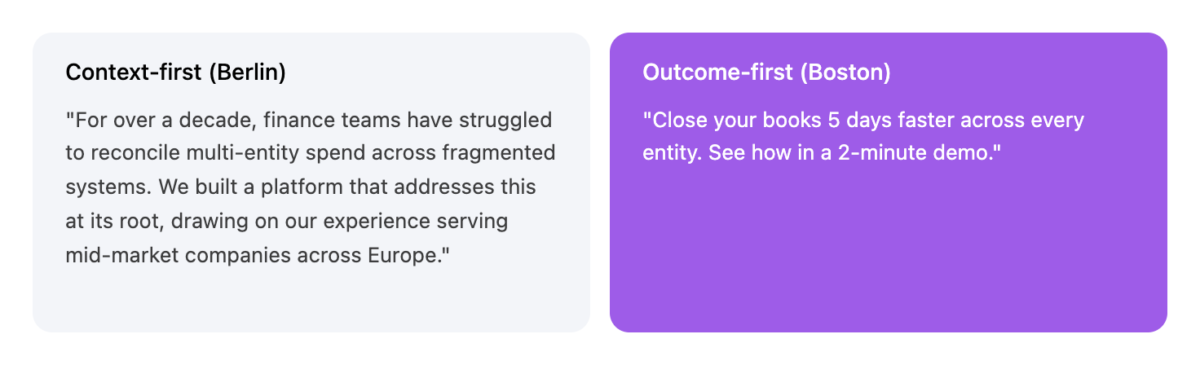
Same product, same claim, radically different odds of holding the reader past the first line.
Translating Your Pitch Deck Into Buyer-Facing Website Copy
The instinct to reuse your pitch deck’s narrative on your website is understandable — it’s polished, it’s been tested on investors, and it took months to get right. It’s also written for the wrong audience. An investor deck answers “why will this company win,” with market size, trajectory, and defensibility as the point. A buyer doesn’t care whether you’ll win the market; they care whether the product solves their problem this quarter.
The practical result is that pitch-deck slides tend to open with market opportunity and end with the ask. Website copy needs to open with the buyer’s problem and end with a clear next step — a demo, a trial, a price. If your homepage still reads like slide three of a Series A deck, that’s usually the reason a US visitor bounces before scrolling.
Outcome-First Headlines vs. Feature-First Headlines
This distinction matters even more once you know how little time you actually have to make it. In TrustRadius’s 2026 B2B Buying Disconnect Report — based on a January 2026 survey of 1,862 technology buyers — 79 percent of buyers said they’d already heard of the product before they began formal research. Awareness is being decided earlier than most vendors assume, often at the headline, not deep in a feature comparison page.
A feature-first headline describes what the product does: “Multi-entity spend management software.” An outcome-first headline describes what changes for the buyer: “Close your books 5 days faster across every entity.” The second version answers the question a scanning visitor is actually asking — what’s in it for me — instead of making them infer it from a category description.
Social Proof as Trust Infrastructure, Not Decoration
European vendors often treat testimonials and logos as a design element — something that fills a section near the bottom of the page. US buyers treat them as part of the evaluation itself.
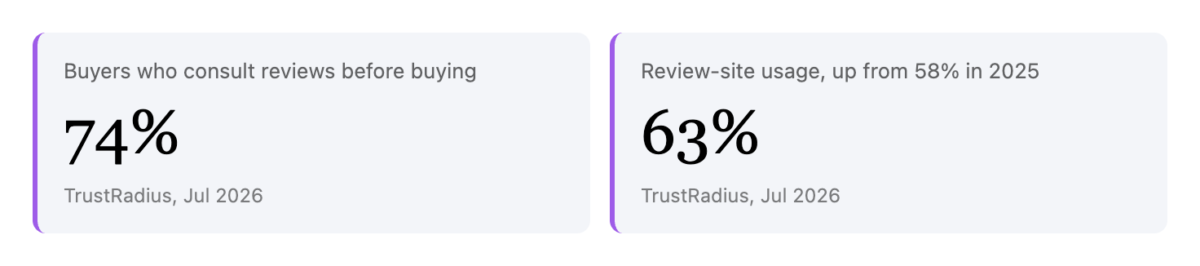
Review-site usage rose from 58 percent of buyers in 2025 to 63 percent in 2026, and 74 percent now consult reviews as part of their purchase decision. That’s not a nice-to-have footer element — it’s infrastructure a US buyer expects to find, the same way they expect a pricing page. If you don’t have enough named US logos yet, building case studies without a marquee logo covers how to make smaller wins carry that same weight.
The Europe-to-US Delta in Tone and Proof
None of this means European directness is wrong or that American copy is somehow more honest — it’s a different set of defaults for what counts as convincing. A European reader often wants to see the reasoning; a US reader wants to see the result and trusts that the reasoning holds up if they ask. Getting the order right — outcome, then proof, then context for whoever wants it — is usually a rewrite, not a repositioning. It’s also one of the reasons the same product commands a different price and a different valuation multiple on either side of the Atlantic, which we cover in more depth in the European SaaS valuation gap.
Directness isn’t a stylistic preference in the US market — it’s the fastest way to prove you understand the buyer’s problem before they’ve decided to trust you enough to keep reading.

ABOUT THE AUTHOR
Written by Luca Lundgren, Founder at Demand Scalers. Luca has five years of demand generation experience working with companies like Simplex Wireless and Dentsu, and holds a Master’s in Marketing from Aalto University.