
AI Advertising in the US: A Guide for European SaaS
October 1, 2026
GEO vs SEO: What Changes When a European SaaS Enters the US
October 15, 2026
How ChatGPT Chooses Which B2B Brands to Recommend, and How to Get on the List
Ask ChatGPT for the best tool in your category and it names a few vendors. For a European SaaS entering the US, yours is often missing. The cause is rarely a bad website. ChatGPT tends to decide who is on the list before it searches, and a brand it does not already associate with the category gets little chance to enter later.
This article covers how that selection works, why a US competitor wins it, how to see your own position in an afternoon, and what to change in the next 60 days. If you are still shaping your wider entry plan, start with the US go-to-market playbook.
Two Filters: What the Model Already Knows, and What It Searches For
ChatGPT brand mentions come from two steps in sequence. Prior knowledge nominates the candidates. Search then confirms them or swaps some out.
Prior knowledge nominates the candidates
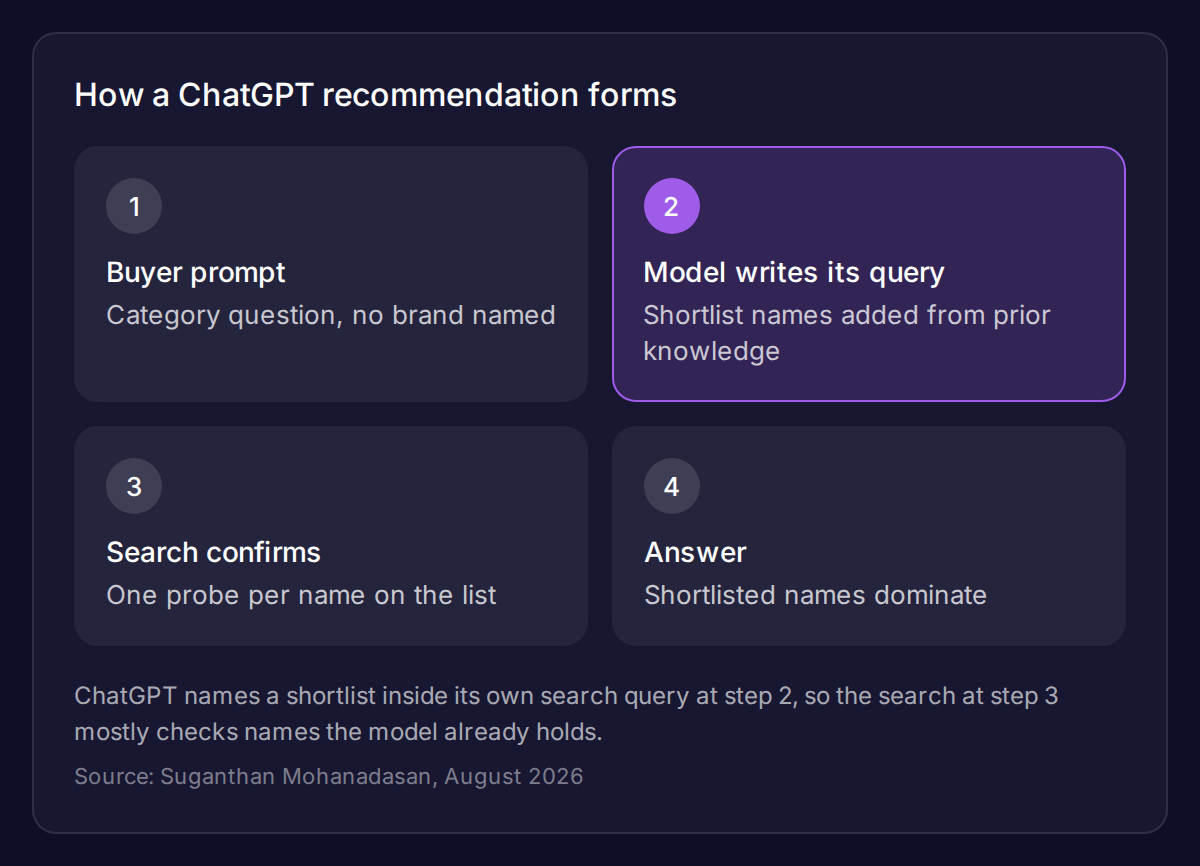
SEO analyst Suganthan Mohanadasan’s analysis, published in August 2026, read the search queries ChatGPT writes for itself, which are visible in the browser’s network traffic. In 21 of 27 conversations, the first query already contained brand names the user never typed. Asked for the best AI note-taking app, ChatGPT’s first search listed seven products by name.
The sample is small and leans toward software and AI tools. That makes it a useful signal for B2B SaaS, and not a measurement of the whole market.
The Bing-fed search confirms or replaces them
OpenAI says ChatGPT search rewrites a prompt into one or more targeted queries and can draw on third-party search providers and its own OAI-SearchBot crawler. Bing is a documented part of that mix. The exact blend is not published and appears to be shifting, so treat Bing as one input to check, and do not assume your Google rankings carry over.
In Mohanadasan’s data, the typical pattern was one search that names a shortlist, followed by one probe per name aimed at that company’s own site.
Why ChatGPT writes brand names into its query before it searches
The model writes from what it has absorbed. A brand present in that signal gets typed into the query. A brand absent from it has to be found by a generic search, which is a much weaker path.
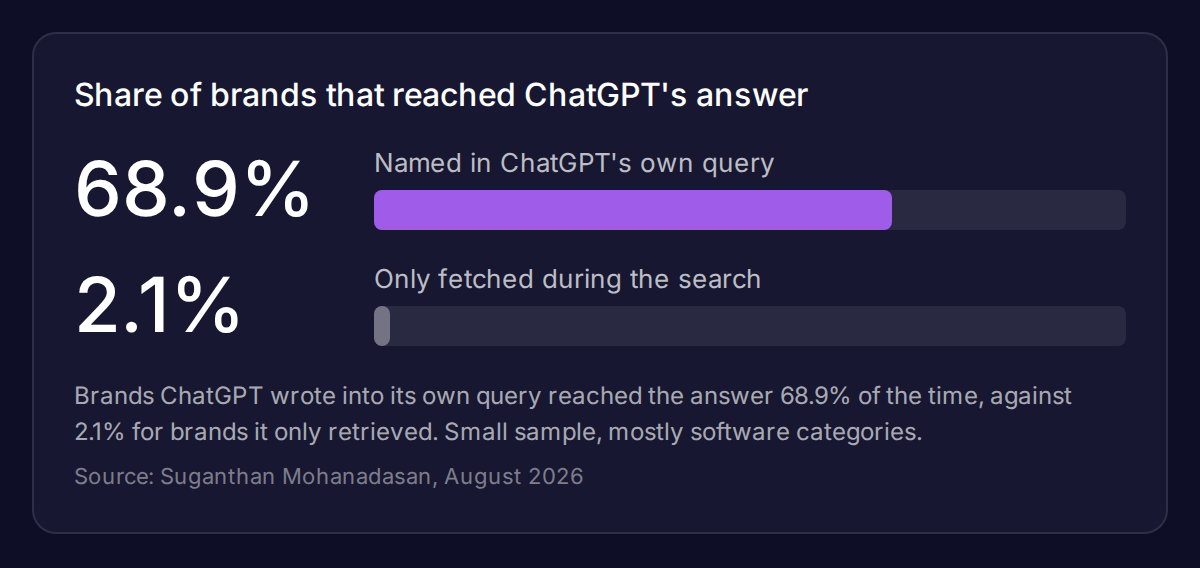
His numbers show the size of the gap. Brands named in ChatGPT’s own query reached the final answer 68.9% of the time. Brands merely fetched during the search reached it 2.1% of the time. His counts treat a whole conversation as one unit, so some brands counted as named were learned earlier in the same chat. The direction is still clear: ranking on page one for a generic query does not put you on the list.
The Signals That Get a Vendor Into the Answer
Three signals recur across the 2026 research. None is proven to cause inclusion, and each is cheap to test.
Consensus across third-party sources
A 2026 preprint on Research Square found that ChatGPT can clearly know a brand and still leave it out of its first query. When the model was allowed to name more brands, many omitted ones came back. That suggests the first query is a limited, ranked list rather than everything the model knows. Brands with stronger category-specific presence across the web ranked higher, and the pattern held in a second, held-out category.
Preprints are not peer reviewed, so weigh this accordingly. For you, it means many independent pages that mention you in the context of your category matter more than one well-optimized page on your own site.
Clarity about who the product is for
A 2026 Peec AI study of 37,804 AI responses, reported by Search Engine Journal, found that rephrasing prompts did not significantly change which brands were recommended. What appeared to matter was how well the web explains a brand.
If your site says “all-in-one platform for teams,” a model has little to attach you to. A sentence that names the category, the buyer and the use case gives it something to repeat. This is positioning work first and SEO work second, and our guide to positioning and messaging covers it for European teams.
Fresh content that OAI-SearchBot can crawl
OpenAI’s crawler documentation says OAI-SearchBot is used to surface sites in ChatGPT search. Sites opted out of it will not be shown in ChatGPT search answers, though they can still appear as navigational links. It is a separate setting from GPTBot, which relates to training. OpenAI notes changes take about 24 hours to apply.
A rule written to block AI training can block search too. Open your robots.txt and confirm OAI-SearchBot is allowed. Then check CDN and firewall bot rules, which robots.txt does not control. OpenAI also recommends allowing its published IP ranges.
Why ChatGPT Recommends Your US Competitor Instead of You
Why ChatGPT recommends competitors over you comes down to timing. Your competitor was on the shortlist before the search began. You were not.
Popularity bias and the incumbent advantage
ChatGPT popularity bias follows from the mechanics above. If the first query is a limited ranking, an established US vendor with years of reviews, comparison pages and press sits near the top of it. Search then confirms that vendor.
A newcomer enters only if a generic search happens to surface it, and the 2.1% figure shows how rarely that turns into a mention.
A brand described mostly in Spanish
No study I found tests brands from outside the US, so treat this section as a working hypothesis built from the mechanism, not a finding.
If ChatGPT ranks brands by category-specific presence, a company whose footprint is mostly Spanish pages on a .es domain has thin presence in the English terms US buyers use. A name that matches a common word or another company adds ambiguity. Three checks make this concrete:
- Search your brand name plus your category in English on Bing and count the third-party results that are in English.
- Check whether your English pages are a native site or a translation.
- Search the exact brand name and see which entity ranks first.
How to Check What ChatGPT Thinks of Your Brand
Start with the query ChatGPT writes, then test realistic prompts.
Read the queries ChatGPT writes for itself
Open ChatGPT in Chrome and open DevTools. In the Network tab, send a category question with no brand names, such as “best [your category] software for a US mid-market company.” Filter for the conversation request, open its response and search for the queries field.
Write down every brand name in those ChatGPT search queries. If yours is missing, the model did not nominate you. The method comes from Mohanadasan’s write-up, and the interface can change.
Prompts with a real buyer’s constraints
Generic prompts return generic shortlists. Write 20 prompts a US buyer would actually type, with constraints such as company size, existing stack, budget and compliance needs. Run each one three times, since answers vary between runs. Log whether you are named, who is named instead, and which sources are cited. Repeat monthly.
The competitor names you collect become your target list for the next section.
What to Do in the Next 60 Days
To get recommended by ChatGPT, change what the web says about you, not only what your site says. Two moves cover most of the work.
A one-sentence positioning AI can repeat
Write one sentence in this shape: “[Product] is a [category] for [buyer] that [outcome].” Use the same wording on your homepage, your G2 or Capterra profile, your LinkedIn page, your press boilerplate and partner listings. Consistency gives the model the same category association from many independent places.
Get onto alternatives lists published in the US
Search Bing for “[top competitor] alternatives” and “best [category] software” and list the pages that rank. Those are the pages a Bing-fed search reads. Pitch inclusion with a clear category description, a public pricing page and a US customer reference, and claim your listing in the directories that appear.
This is slow third-party work. No study I know of gives a reliable time to inclusion, so re-run your 20 prompts every month and track whether you appear. If you want a team to run it, see our SEO and GEO service. Paid presence in the same channel is a separate decision, covered in ChatGPT Ads for SaaS.