
AI Ad Creative Tools for SaaS: A Buyer’s Guide
September 29, 2026
How ChatGPT Chooses Which B2B Brands to Recommend, and How to Get on the List
October 8, 2026

AI Advertising in the US: A Guide for European SaaS
Every major ad platform now runs on automation that decides who sees your ads, where, and at what price. For a European SaaS company entering the US, that changes what you control and what you need to get right before spending a euro. The targeting levers that used to separate a good media buyer from an average one are mostly gone. What remains is the quality of the signal you feed the algorithm, the creative it has to work with, and how honestly you measure the result.
This guide maps the AI ad landscape for a team entering the US, then points to a deeper piece on each platform and each cross-cutting problem.
Why AI advertising changes the rules of US market entry
From manual bidding to algorithmic optimization
A few years ago, a media buyer chose keywords, set bids, and drew audience boundaries by hand. Today you hand the algorithm a conversion goal and a budget, and it decides the rest. That works well when the goal reflects real revenue and badly when it doesn’t, because the algorithm will optimize toward whatever event you gave it with total commitment, including a cheap form fill that never becomes pipeline.
What this means for a small European marketing team
A lean team can now run campaigns that once needed a large agency, but the failure modes are quieter. Spend leaks into unqualified leads without any alarm going off. The skill that matters most is no longer campaign mechanics but feeding clean conversion data back to the platforms and judging results against pipeline instead of platform dashboards.
The AI ad platform ecosystem in 2026
Google’s Performance Max runs a single campaign across Search, Display, YouTube and more. It was built for ecommerce, and in B2B SaaS it only works once your CRM feeds qualified conversions back into Google Ads. Without that, it chases the cheapest lead available.
Meta’s Advantage+ automates targeting and creative combinations on Facebook and Instagram. The headline ROAS gains come from high-volume accounts, and most B2B SaaS teams do not generate enough conversion events for the algorithm to learn reliably.
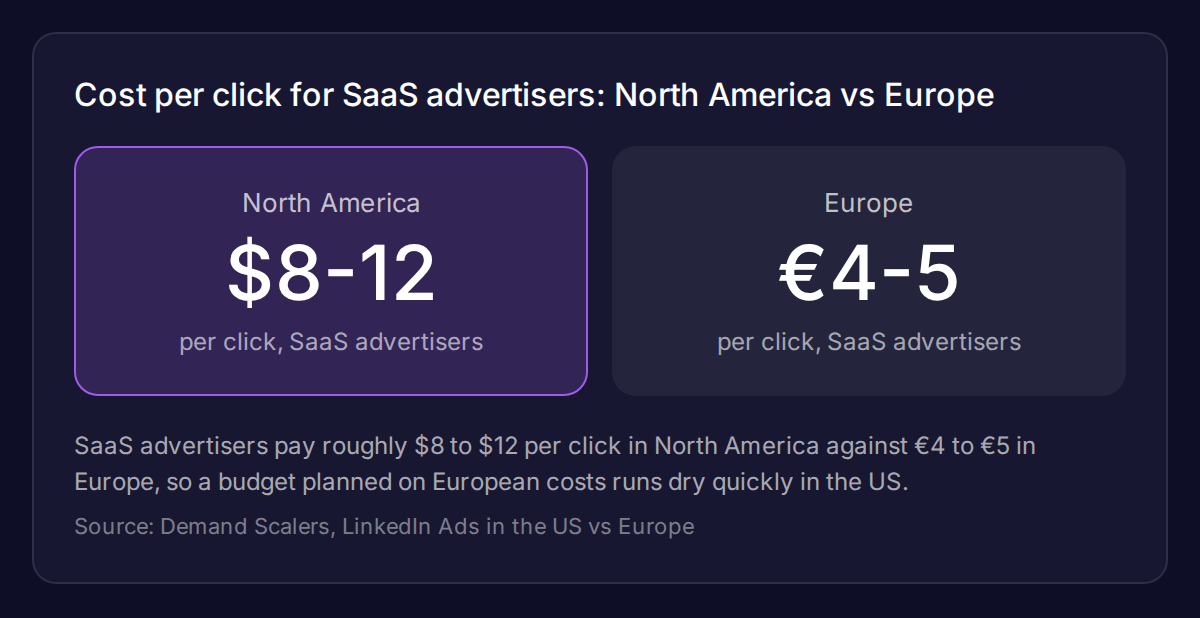
LinkedIn remains the most precise B2B channel and the most expensive, and the US versus Europe cost gap is large enough to break a budget planned on European numbers. Its AI layers, such as Predictive Audiences and Thought Leader Ads, change the economics more than any bid setting does.
The newest surface is the AI answer engine. ChatGPT Ads reached Europe in August 2026, with access still running through OpenAI’s partners rather than open self-serve. It is early, worth a small experiment, and not yet a channel to build a plan around.
How to choose your first AI ad platform
If you come from LinkedIn Ads in Europe
Do not copy the European account across. Split US and European budgets into separate line items from day one, test Thought Leader Ads before scaling brand-page campaigns, and check that your deal size can absorb US click costs before committing.
If you have a small test budget
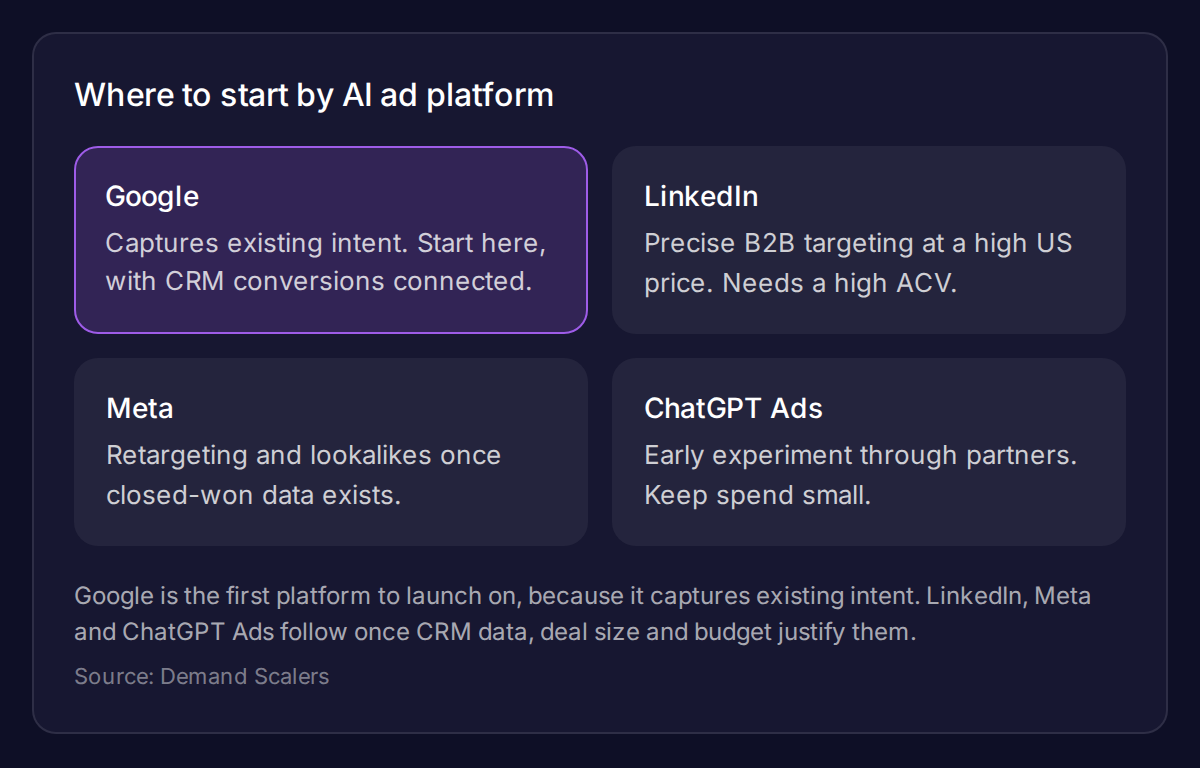
Start with Google search intent, where buyers are already looking, and keep it on the safer end of Google’s automation until your CRM conversions are connected. Add Meta only once you have closed-won customers to seed lookalike audiences, and treat ChatGPT Ads as a small experiment.
Building creative at the speed AI demands
Automation controls the “who” and “where”. The “what” is still yours, and the platforms need enough creative variety to test within. A new category of AI ad creative tools now generates and scores variants before you spend on them, which suits a team without a large design function. Use predictive scores to decide what to test first, not as the final word on what to run.
Measuring what AI doesn’t let you see
Your ad dashboard, your CRM and your billing system will not agree, and a large share of B2B buying research happens where no pixel can follow, including inside AI assistants. The practical fix is attribution built for the dark funnel: CRM conversions fed back to the platforms, an open-text “how did you hear about us” field at high-intent forms, reporting windows matched to your sales cycle, and cost per SQL as the number you report.
Common mistakes European SaaS make launching AI ads in the US
Four mistakes recur. Teams budget with European costs and run dry before learning anything. They leave the platform optimizing toward form fills instead of qualified pipeline. They launch on four channels at once with too little volume on any of them. And they judge results by in-platform dashboards instead of cost per SQL.
Each of these is avoidable, and all four come from the same root cause: treating the US as a larger version of the European market instead of a different cost structure with different buying behavior. A short, sequenced launch fixes most of it.
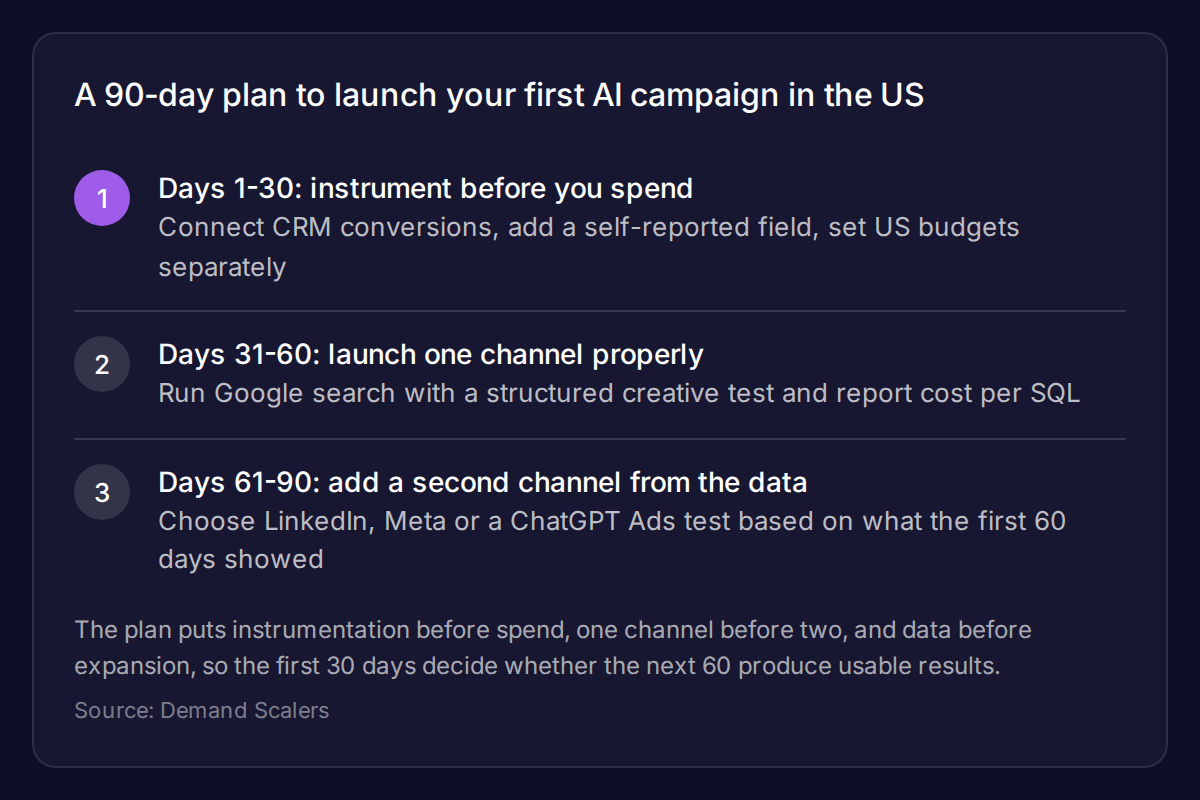
A 90-day plan to launch your first AI campaign in the US
The plan below puts instrumentation before spend, one channel before two, and data before expansion. The first thirty days cost very little media budget and decide whether the following sixty produce usable results.