
Demand Generation for European SaaS Companies Expanding to the US
July 15, 2025
SOC 2 for European SaaS Companies Selling to US Enterprise Buyers
September 15, 2025

SaaS Pricing Strategy for the US Market
Your US pricing page is probably still running on European instincts. That’s the first thing to fix, and it’s rarely about the number itself.
Why European Pricing Undersells in the US
European SaaS companies frequently underprice on entry into the US, treating a lower number as a way to compete on value the way they would at home. In a market where price often functions as a credibility signal rather than a courtesy, that instinct backfires: underpricing reads as under-confidence, not generosity. A buyer comparing three vendors at wildly different price points doesn’t assume the cheapest one is the best deal — they assume it’s the one missing something.
This isn’t a European failing so much as a mismatch of contexts. In many European markets, long-term value and ROI calculations dominate the buying decision, and a lower entry price signals patience and partnership. American buyers, especially at the enterprise tier, read price as a proxy for maturity: too cheap, and the product looks unproven regardless of what it actually does.
ACV Benchmarks: US vs Europe
The gap isn’t just a feeling — it shows up directly in contract size.
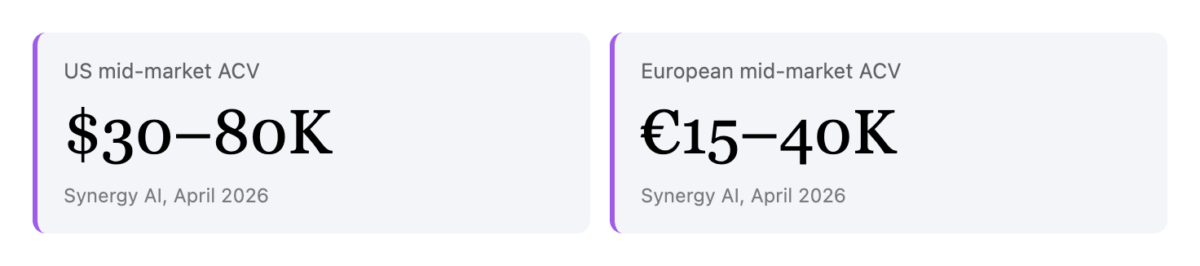
Synergy AI’s cross-border SaaS analysis puts a US B2B SaaS company serving mid-market customers at $30,000 to $80,000 in annual contract value on a stable expansion path, against €15,000 to €40,000 for a European peer serving a matched segment. That’s not a currency conversion gap — a European mid-market ACV converted to dollars still lands well under the US floor. The difference reflects larger addressable markets, more aggressive expansion norms, and buyers who’ve been trained by the market itself to expect higher price tags at that tier.
Treat this as a floor to negotiate up from, not a target. A company entering with a European-calibrated ACV is often leaving 30 to 50 percent of achievable contract value on the table before the first sales conversation even happens.
Should You Run Region-Specific Pricing or One Global Price?
Most early-stage companies default to one global price for simplicity — same number, same tiers, everywhere. That’s defensible early on: it’s easier to manage, keeps the brand consistent, and simplifies revenue forecasting. The tradeoff shows up as you scale into multiple regions with genuinely different willingness to pay.
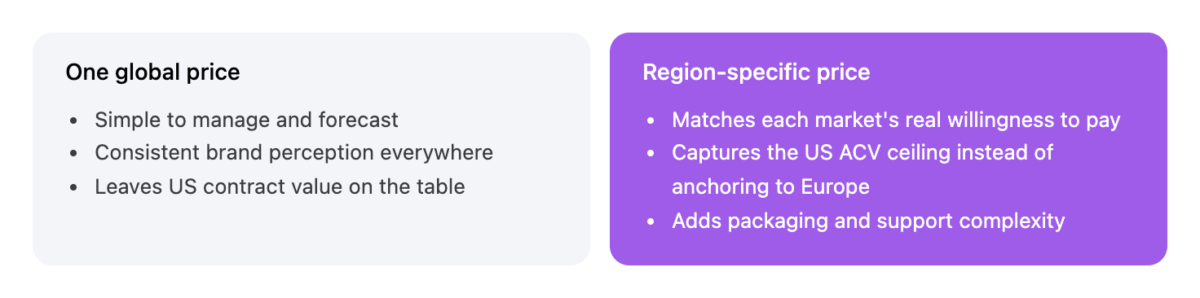
True price localization goes beyond swapping euros for dollars: it means understanding how a specific market perceives your category and what it’s actually willing to pay, then pitching the number to match — not just translating it. If your US price is a straight currency conversion of your European price, you likely haven’t localized it at all; you’ve just relabeled it.
Packaging for a Self-Serve, Speed-Expecting Buyer
US buyers, even at the enterprise tier, increasingly expect the experience to resemble consumer SaaS: sign up, install, see value fast. A pricing page that hides everything behind “contact us,” or a trial that requires a sales call just to activate, costs you deals to a competitor whose site simply answers the question.
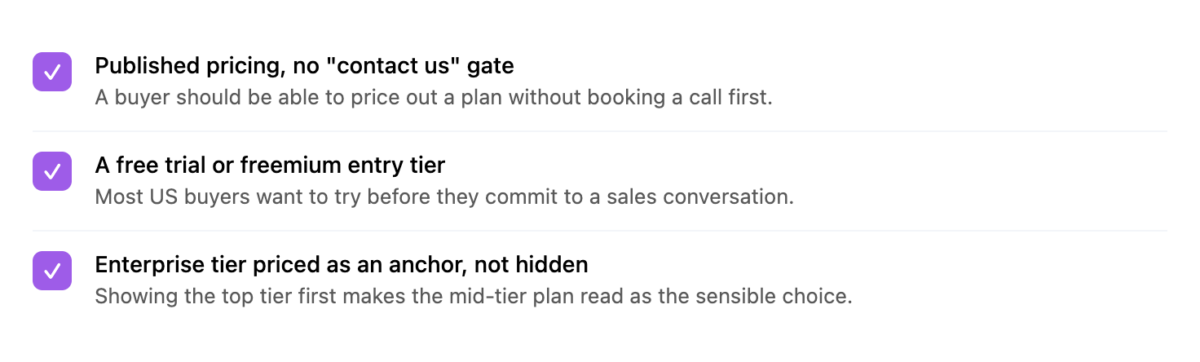
That last point matters more than it looks: showing your most expensive, fully-loaded plan first establishes a credible upper reference point, which makes everything below it look like the reasonable middle ground rather than the default cheap option. It’s a packaging decision, not just a pricing one — and it’s one place where an unclear pricing page compounds into a stalled deal well before your sales team ever gets involved, which is exactly the pattern behind why enterprise deals stall in US procurement.
The Europe-to-US Delta: Willingness to Pay and Premium Positioning
The trust gap between European and US SaaS isn’t limited to pricing pages — it prices directly into how the whole company gets valued. As of Q1 2025, the CEE SaaS Index for European software companies closed at a 3.65x revenue multiple against 6.26x for comparable US SaaS companies at the same stage and growth rate — a roughly 1.7x gap despite similar fundamentals, as we cover in more depth in the European SaaS valuation gap.
Pricing is one of the few levers you control directly inside that gap. A Gartner study found that 67 percent of SaaS companies that successfully expanded internationally ran deep competitive pricing analyses for each target market before entry, rather than exporting a home-market number and hoping. Underpricing in the US doesn’t just leave revenue on the table — it reinforces the exact discount you’re trying to close. Reprice deliberately, treat your US number as a credibility signal rather than a courtesy, and let the ACV benchmarks above set your floor, not your ceiling.
If you want a working example of how we sequence pricing alongside the rest of a US launch, our market entry framework covers it end to end.

ABOUT THE AUTHOR
Written by Luca Lundgren, Founder at Demand Scalers. Luca has five years of demand generation experience working with companies like Simplex Wireless and Dentsu, and holds a Master’s in Marketing from Aalto University.