

Demand Generation KPIs for Measuring US Market Entry
November 15, 2025
When to Hire Your First US Sales Leader as a European SaaS Company
January 15, 2026

US Market Entry Strategy for European SaaS Companies: The Demand Generation Playbook
Your European market entry playbook wasn’t wrong. It was built for a different buyer, a different sales cycle, and a different bar for trust. None of that transfers to the US by default — it has to be rebuilt, piece by piece, starting well before you hire your first US salesperson.
Why Your European Market entry Playbook Won’t Work in the US
US buyers evaluate and move in hours, not days. An outreach sequence or a sales process calibrated for a European decision cycle — where relationship-building and thoroughness earn trust over time — reads as slow, or worse, irrelevant, to a US buyer who’s already comparing three vendors and expects an answer today. Even at the enterprise tier, US buyers increasingly expect a self-serve first step: pricing they can see, a trial they can start without a call, a way to answer their own questions before talking to anyone. A European motion built entirely around a discovery call as the first touch is fighting the market’s default expectation, not just a stylistic preference. The opportunity on the other side of that adjustment is real:
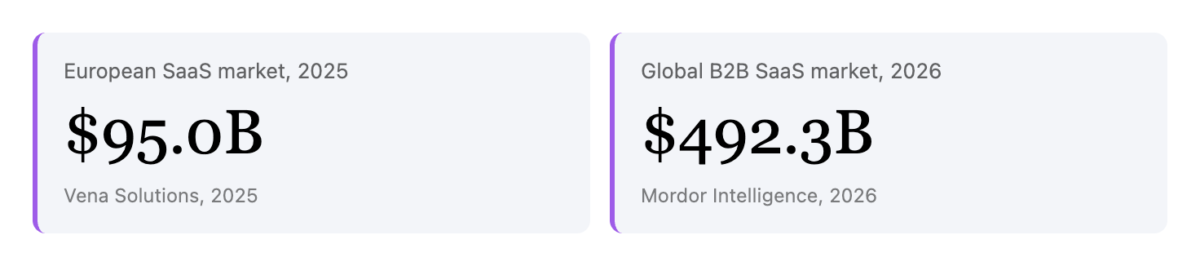
The gap between those two numbers is the reason a European-calibrated playbook, run unchanged, leaves most of the addressable opportunity untouched.
Demand Generation and Positioning Before You Hire a Salesperson
Most European teams reverse the order that actually works: they hire a US VP of Sales before they have any evidence that US demand is real, then discover the problem was never execution. Evidence is repeatable and measurable — consistent inbound from one geography over months, an existing customer asking for US support. Noise feels just as exciting but predicts nothing — a single deal from a personal connection, generic conference enthusiasm, a board member repeating that “the US is big.” Confusing the two is, consistently, the most expensive mistake to unwind after you’ve already hired against it. The discipline is to prove demand with a demand-generation budget first, sequencing channels deliberately — outbound, then paid search, then content and SEO, then partnerships — rather than running all of them at once on a thin budget and getting noise back instead of signal.
None of that works, though, if the message underneath it is still written for the wrong reader. An investor deck answers “why will this company win” — market size, trajectory, defensibility. A buyer doesn’t care whether you’ll win the market; they care whether the product solves their problem this quarter. US buyers scan for the outcome first and the context second — the opposite order many European teams default to. “Multi-entity spend management software” describes what the product does. “Close your books 5 days faster across every entity” describes what changes for the buyer. Getting the headline, the pitch-deck-to-website translation, and the social proof right is one of the highest-leverage rewrites available before you spend a dollar on paid acquisition.
Pricing and Trust: What US Buyers Actually Evaluate
European SaaS companies routinely under-price on US entry, treating a lower number as a value signal the way they would at home — when in the US, price often reads as a proxy for maturity instead. The ACV gap between US and European mid-market deals is wide enough — $30,000 to $80,000 in the US against €15,000 to €40,000 in Europe for a matched segment — that a straight currency conversion of your European price usually isn’t localization at all, just a relabeled number that leaves contract value on the table before the first sales conversation happens. One global price is simpler early on; it stops being defensible once you have enough US volume to know it’s systematically leaving money on the table.
Pricing and positioning both die quietly in procurement if the trust signals underneath them aren’t there yet.

Over 80 percent of US enterprise procurement teams require a SOC 2 report before a vendor clears security review — and a well-respected ISO 27001 certification, on its own, usually isn’t enough to skip that requirement. GDPR is a separate obligation entirely, not a substitute for either. You don’t need the audit finished to start: publishing “SOC 2 Type II available under NDA,” even while a Type I is still your current report, sets the right expectation. Building that compliance and trust program deliberately, rather than scrambling once a deal stalls in security review, is what keeps the pricing and positioning work above from dying in procurement.
Channels and Measurement: Proving the Motion Works
US intent-data coverage runs deeper than Europe’s, so paid search and outbound can lean on stronger buyer-intent signals than most European teams are used to. Paid search captures demand that already exists; outbound, calibrated to US contact data rather than recycled from a European list, is usually the first channel worth proving. Content and SEO build the demand that doesn’t exist yet and compound over months rather than producing a first-month result — not the channel for your first sign of traction, but the one that pays off after the others have validated the message. Partnerships are worth adding only once the first channels are already producing pipeline of their own.
None of that is worth running if you can’t tell whether it’s working. Traffic and downloads are easy metrics to grow and easy to mistake for progress. In the first few months, pipeline data is too small and too new to trust — track branded search volume, return visits to pricing pages, and demo requests from a consistent segment instead. Once pipeline exists, marketing-sourced pipeline share is the number boards actually want, but published benchmarks for that share disagree with each other by 20 or more points depending on attribution method. Treating your own first 90 days of US data as the baseline, rather than borrowing someone else’s, is the only reliable way to know if the motion is actually working.
The Europe-to-US Delta: What Actually Changes
Response speed, self-serve expectations, and how price and proof get read all shift the moment you cross the Atlantic — none of it a reflection of product quality, just a different set of market defaults. Trust and compliance documentation gets requested earlier in a US deal, not after terms are agreed the way it more often does in Europe; waiting until a deal is verbally won to start the SOC 2 conversation is waiting too long. None of the pieces above are fast individually, and they compound: pricing without trust signals stalls in procurement, channels without positioning waste spend, and nothing is measurable without a baseline you’ve actually built yourself. A serious, non-opportunistic US entry runs longer than most founders expect — which is exactly why sequencing the work in the order above matters more than trying to do all of it at once.

ABOUT THE AUTHOR
Written by Luca Lundgren, Founder at Demand Scalers. Luca has five years of demand generation experience working with companies like Simplex Wireless and Dentsu, and holds a Master’s in Marketing from Aalto University.