
When to Hire Your First US Sales Leader as a European SaaS Company
January 15, 2026
How to Validate US Demand Before You Commit to an Expansion
March 15, 2026

Delaware C-Corp: What Structure Your European SaaS Needs to Sell in the US
Legal structure stops being a footnote the moment a US enterprise buyer wants to sign. Below $50,000 in US revenue, the operational overhead of a US entity rarely justifies the complexity, according to a 2026 founder guide on Delaware setup for foreign founders. Above that threshold, the tax efficiency and customer confidence a proper entity provides start to outweigh the cost of setting one up — the same threshold that should shape your US market entry sequence more broadly.
Why this decision arrives faster than founders expect
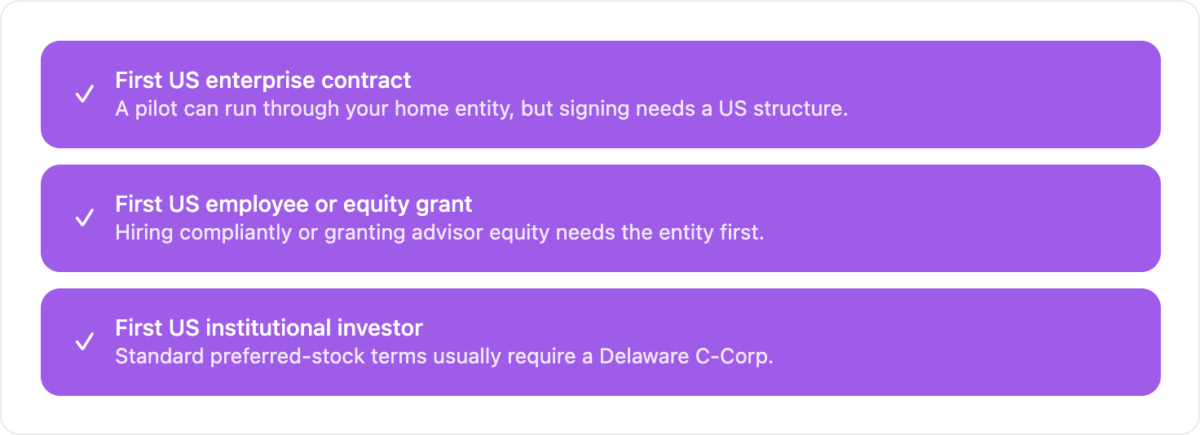
You can sign a letter of intent and even run a pilot through your home-country entity while a Delaware setup gets sorted properly — plenty of founders have funded their first US structure this way. But the moment a US enterprise wants to actually execute a contract, the absence of a US entity becomes the blocker, not a detail to handle later. It’s one more reason demand validation and legal readiness need to move together, not in sequence.
The three options on the table
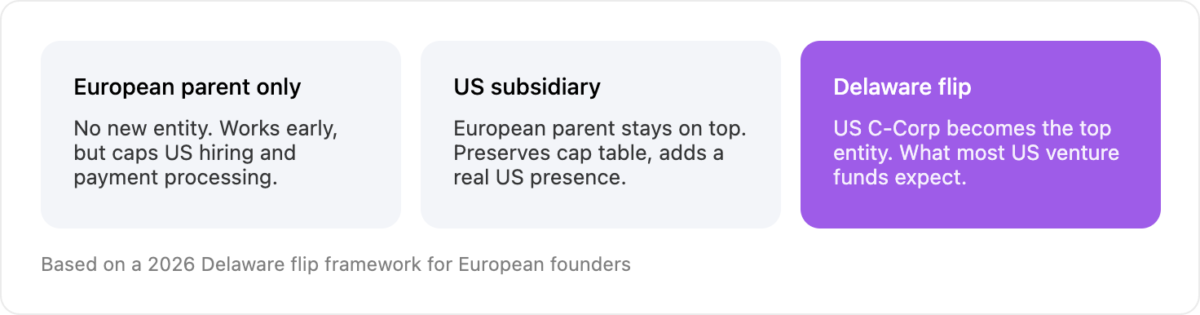
A European founder weighing US structure is really choosing between three shapes.
Keep the European parent and sell anyway. Works for a while, especially if non-US revenue and team stay dominant, but it caps how cleanly you can hire US staff or process US payments.
A US subsidiary under the European parent. The parent stays on top, a US entity sits below it purely for US operations. This preserves the existing company and cap table while giving a real US operating presence, though it may not satisfy every US investor’s preference for standard paperwork.
The “flip” to Delaware. The top holding company changes from the non-US entity to a Delaware C-Corp, with the original company becoming a subsidiary underneath. This is the shape most US venture funds expect, since preferred stock, option pools, and board mechanics all follow familiar templates.
C-Corp vs. LLC: why almost every investment-track SaaS chooses C-Corp
Once the choice is a US entity, the next fork is C-Corp versus LLC. A foreign-owned LLC offers pass-through taxation and low setup costs, but carries strict IRS reporting obligations — a missed Form 5472 filing alone carries a $25,000 penalty, according to James Baker CPA’s guide for SaaS founders, the one external citation worth linking here. A Delaware C-Corp brings corporate income tax and ongoing state fees, but it’s the standard structure venture-backed SaaS companies use, since it supports stock issuance, SAFE agreements, and employee option pools without restructuring later.
Some founders start lean regardless: one India-based founder launched on a Wyoming LLC paying only a $60 annual license tax, and only moved to Delaware once US investor interest made the standard structure necessary.
Triggers that force a move
There’s no single ARR figure that makes this decision for you, but three concrete triggers tend to force it:
What you can do before you have an entity
Founders often run further than they expect on their home-country structure alone. One well-known example: a European SaaS founder chose to incorporate directly as a Delaware C-Corp rather than starting with a home-market entity, largely to avoid the bureaucracy and investor friction of local notarial process. Not every founder needs to move that fast — but the pattern holds: the longer a European-only structure stays in place after a real US trigger hits, the more expensive it becomes to unwind, which is exactly the kind of credibility gap our positioning and messaging work is built to close.
The most expensive mistakes to undo later
Waiting past a genuine trigger rarely saves money. It usually means renegotiating a contract clause, re-issuing equity under time pressure, or explaining to a new US investor why the cap table still runs through a foreign parent. Getting this right alongside your broader go-to-market strategy means fewer surprises once revenue starts moving, and it’s the same reason SOC 2 shows up on this list — see our post on SOC 2 for US enterprise buyers for the compliance side of the same trust-building work.
ABOUT THE AUTHOR
Written by Luca Lundgren, Founder at Demand Scalers. Luca has five years of demand generation experience working with companies like Simplex Wireless and Dentsu, and holds a Master’s in Marketing from Aalto University.