

Delaware C-Corp: What Structure Your European SaaS Needs to Sell in the US
February 15, 2026
US vs. Europe SaaS Benchmarks: CAC, ACV, and Sales Cycle Length
April 15, 2026

How to Validate US Demand Before You Commit to an Expansion
The number one reason startups fail isn’t picking the wrong channel or the wrong price — it’s building for demand that was never really there. That’s the finding CB Insights keeps surfacing across startup failure post-mortems, and it applies just as directly to a European SaaS company deciding whether to commit real budget to the US.
The most expensive mistake: scaling infrastructure for demand that doesn’t exist yet
Market size is the least useful early signal. A huge addressable market says nothing about whether a specific US buyer has budget, urgency, or internal permission to change how they work right now. What actually predicts traction is market pressure — the current way of doing things being too expensive, too slow, too manual, or too hard to explain. Pressure is what makes a buyer move; a big TAM slide is not.
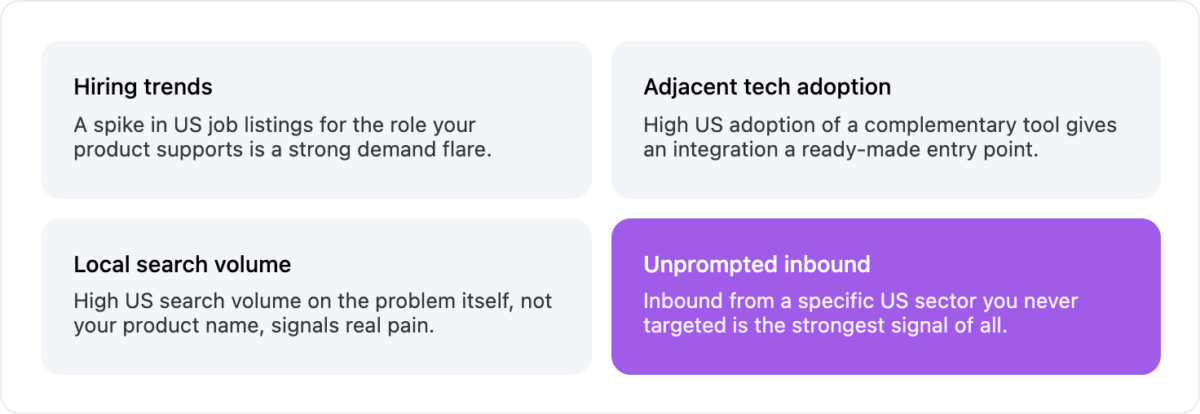
Signals that actually predict US traction
Before committing to a full US market entry playbook, look for concrete, checkable signals rather than gut feel.
How to run the experiment before you hire anyone
None of this requires a US team to test. A GTM playbook framework for market entry is explicit about the order of operations: validate the assumptions first, then commit resources, not the other way around. Concretely, that means five to ten real customer interviews asking whether a US prospect would actually pay for this, not whether they like the idea. It means testing pricing and packaging assumptions from your home market rather than importing them wholesale, since a European ACV rarely translates directly. And it means going indirect first where possible — working through a local partner or reseller tests real demand with far less capital than opening a US entity and hiring a team upfront.
Paid campaigns, a scoped MVP, and genuine pre-selling all serve the same purpose: they convert a guess into a data point before you’ve spent real money finding out the hard way.
The three conditions that should all be true before you invest seriously
Real commitment — hiring, opening an entity, building a full US demand generation motion — deserves more than one good signal. Three conditions should hold at once: repeatable product-market fit with a documented, teachable sales process; demand validated by at least three independent sources over six months, not one lucky deal; and enough capital to fund an 18 to 24 month runway before expecting meaningful return. A company expanding on the strength of one enthusiastic prospect is expanding on anecdote.
What to do if it’s still noise
If the signal isn’t there yet, that’s not a failure — it’s information. Keep the experiment cheap: continue the interviews, watch the hiring and search-volume signals, and hold off on the entity and the first hire. Once real traction shows up, the KPIs that prove it’s working — covered in our guide to measuring US market entry — will tell you fast whether the next dollar spent is working or not.

ABOUT THE AUTHOR
Written by Luca Lundgren, Founder at Demand Scalers. Luca has five years of demand generation experience working with companies like Simplex Wireless and Dentsu, and holds a Master’s in Marketing from Aalto University.