

How to Scale Your US Customer Base as a European SaaS Company
June 15, 2026
Google Performance Max for B2B SaaS: A Guide to Not Burning Your Budget
August 15, 2026
ChatGPT Ads for SaaS: What European Teams Need to Know
OpenAI began testing ads inside ChatGPT in the US in February 2026. By August it had expanded to eight more markets, then added 31 European countries in one move, its largest expansion to date, according to OpenAI’s own announcement. For a European SaaS team building US demand generation, that timeline matters less than the question underneath it: is this a channel worth building into next year’s plan, or a distraction while Google and LinkedIn still do the heavy lifting.
The honest answer is that it’s early, but the audience overlap is not trivial. People come to ChatGPT already having described their team size, their workflow problem, and often their budget, before they ask for a recommendation. That’s a richer intent signal than a keyword search gives you, and it arrives before the user has typed anything into Google.
Who actually sees these ads
OpenAI’s testing so far targets two segments only: the Free tier, and the newer low-cost paid tier. The two priciest subscription tiers are deliberately excluded from the ad experience, a positioning choice that protects the expectations of paying power users while monetizing the much larger pool of free and entry-level accounts.
That split matters for who you’d actually be reaching. The low-cost tier attracts a user who is willing to pay a small amount for AI tools, price-conscious enough to skip the premium tiers, and actively using the product for research and productivity, not casual chat. For a team targeting early-stage founders or SMB decision-makers, that’s a closer match than it first sounds. For a team selling exclusively into enterprise accounts on six-figure contracts, it’s a weaker one, since the highest-spending, most senior users sit on the excluded tiers.

Why intent here is different from a Google search
A keyword typed into a Google search box carries almost no context. A ChatGPT conversation that ends in a request for a software recommendation carries the whole conversation that led there: the constraints, the objections already raised, the budget range mentioned in passing. That’s a pre-qualification layer keyword targeting was never built to replicate, and it’s the main reason this channel is worth tracking even before it has a mature bidding system or a reporting suite that looks like Google Ads.
What “answer independence” actually promises
OpenAI has been explicit that ads will not bias ChatGPT’s organic answer. Paying for a placement doesn’t buy a mention in the response itself; the ad sits in a separate, labeled box next to it.
That’s a narrower guarantee than it sounds. It protects against your ad purchase corrupting the model’s answer, not the reverse: nothing about running ads improves the odds that ChatGPT’s organic answer mentions your product at all. Those are two separate problems that happen to sit on the same screen, and treating them as one is the most common mistake teams will make with this channel in its first year.

How to get in before self-serve exists
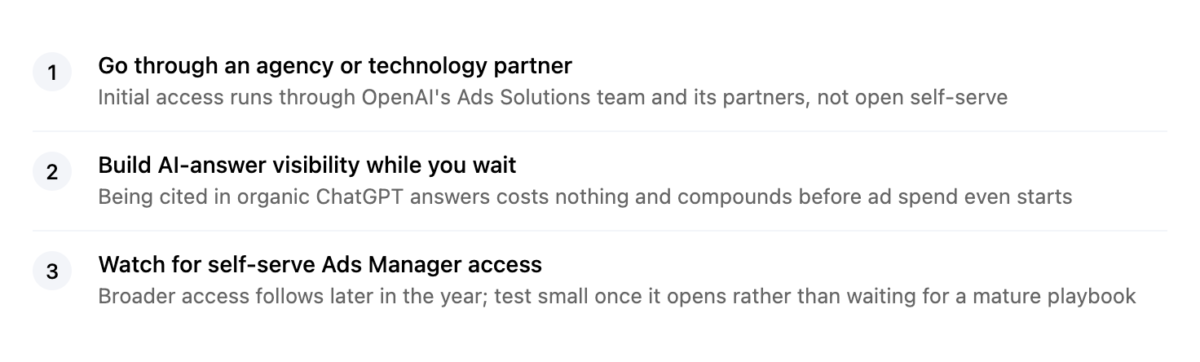
Ads Manager isn’t broadly self-serve yet. Access currently runs through OpenAI’s Ads Solutions team, agency partners, and technology partners, with wider self-serve access expected later this year.
That’s not a reason to wait passively. The visibility work that determines whether your product gets mentioned in an organic ChatGPT answer, the same work behind a strong US positioning, costs nothing to start now and compounds regardless of when paid access opens up.
Where this fits in your channel mix
Nothing here changes the channel sequencing that already works: outbound first to prove demand is real, paid search next because it captures intent that already exists, content and AI-answer visibility building in parallel because they compound slower but don’t require ad spend to start. ChatGPT Ads slots in as an experimental line inside that paid search budget, not a replacement for it, and the same KPI discipline that applies to Google or LinkedIn applies here: track branded search lift and demo requests from a consistent segment before trusting any in-platform number, since attribution tooling for this channel is close to non-existent right now.
The bigger strategic point sits inside the broader US market entry playbook: channels without positioning waste spend, and that’s just as true for a six-month-old ad platform as it is for Google Ads on day one.
ABOUT THE AUTHOR
Written by Luca Lundgren, Founder at Demand Scalers. Luca has five years of demand generation experience working with companies like Simplex Wireless and Dentsu, and holds a Master’s in Marketing from Aalto University.