

Building a US Customer Success Model as a European SaaS Company
May 15, 2026
ChatGPT Ads for SaaS: What European Teams Need to Know
July 15, 2026

How to Scale Your US Customer Base as a European SaaS Company
Every European B2B SaaS company that gets serious about the US eventually hits the same wall: the playbook that built your European customer base doesn’t transfer cleanly. The market is bigger, the competitive bench is deeper, and the assumptions baked into your pricing, your sales process, and even your legal structure need to be rebuilt, not translated. This post is the map for that rebuild — the sequence to follow, the decisions that actually matter, and where to go deeper on each one.
Why the US is a different game, not a bigger version of the same one
It’s tempting to treat the US as “Europe, but one market instead of twelve” — no more VAT complexity, no more works councils, one language, one currency. That simplicity is real, but it comes with a tradeoff: US buyers have a much deeper bench of alternatives to compare you against, US sales cycles carry expectations European buyers don’t have, and a European vendor starts the relationship with a credibility gap a domestic competitor never has to close. Treating the US as easier because it’s more homogenous is exactly how founders under-invest in the parts of the expansion that actually determine whether it works.
Start with evidence, not ambition
The single most expensive mistake in this entire process is building US infrastructure — a team, an entity, a marketing budget — around demand that turns out to be one enthusiastic prospect rather than a real pattern. Before committing real resources, look for demand evidence rather than demand noise: recurring inbound from a specific US sector, an existing customer asking you to support their US operations, or a US-native competitor visibly taking share in your category. One big deal that arrived through a personal connection is not the same thing as a pattern, no matter how good it feels.
Real commitment deserves three conditions to be true at once: a repeatable, documented sales process; demand validated by at least three independent sources over six months; and enough capital funded for an 18 to 24 month runway before expecting meaningful return. Our guide to validating US demand walks through exactly how to run this experiment cheaply — through customer interviews, a scoped MVP, or an indirect partner test — before you’ve spent real money finding out the hard way.
Get the legal structure right before it becomes a blocker
Legal structure is easy to postpone right up until the moment a US enterprise buyer actually wants to sign — at which point it stops being a strategic decision and becomes an emergency. Three concrete triggers tend to force the issue regardless of how prepared you feel: the first US enterprise contract, the first US employee or equity grant, and the first US institutional investor. None of these arrive on a schedule you control.
Most European founders end up choosing between three shapes: keeping the European parent as-is and selling anyway, adding a US subsidiary underneath the existing parent, or flipping the top entity to a Delaware C-Corp — the structure most US venture funds expect, since it supports stock issuance and standard preferred-stock terms without restructuring later. Our Delaware C-Corp guide breaks down all three options, the C-Corp versus LLC decision, and the actual triggers that should drive timing, so this doesn’t become the thing that stalls a deal already in motion.
Hire a leader before you hire a seller
The most common sequencing mistake in US expansion is testing the market with a single Account Executive and expecting them to build it alone. An AE typically lacks the seniority to navigate a new market, shape the sales motion, and stay aligned with a leadership team overseas — which is exactly why the first US hire needs to be a leader, not just a closer.
That first hire sets the calibration point for every hire that follows. Get the role wrong and you either overpay for management capacity you don’t need yet, or hire someone with no one to manage and nothing to calibrate against. Our guide to hiring your first US sales leader covers the signals that tell you you’re ready, the difference between hiring a leader and hiring a seller, and the specific difficulty of recruiting this role from Europe rather than domestically.
Support and success come next, and founders consistently postpone this longer than they should. Support becomes non-negotiable the moment your first US customers sign — a customer whose 9am Eastern ticket sits unanswered until your European office opens has already had a worse experience than a US-based competitor would give them, and that gap compounds fast if it’s not addressed early. Our US customer success model guide lays out how to cover the US without building a full team on day one — a hybrid model outsourcing Tier 1 while keeping Tier 2 and escalations in-house, translating your help center before hiring language-specific agents, and bringing on a dedicated Customer Success Manager only once there’s a base worth expanding.
Benchmark against the right numbers, not an unadjusted US median
Comparing your European metrics to a blended US benchmark is one of the fastest ways to make a healthy team feel like it’s underperforming. Early-stage European ACVs genuinely run lighter than the US equivalent for the same product, and cycles genuinely run longer — a dozen procurement styles, VAT quirks, and works-council approvals all add friction the headline US numbers never account for. That’s not a performance problem. It’s a different starting line.
CAC payback, in particular, varies enormously by deal size: a sub-$5K ACV motion typically pays back in around 11 months, while a $50K-$100K enterprise motion runs closer to 22 months — benchmarking one against the other tells you nothing useful about either. Sales cycle length follows a similar pattern, roughly doubling or tripling with every zero added to the ACV, and security reviews like SOC 2 now add two to four weeks even at mid-market deal sizes. Our US vs. Europe SaaS benchmarks guide breaks all of this down by segment, so you’re comparing yourself against the right band instead of an average that blends a 30-day deal with a 270-day one.
Putting the sequence together
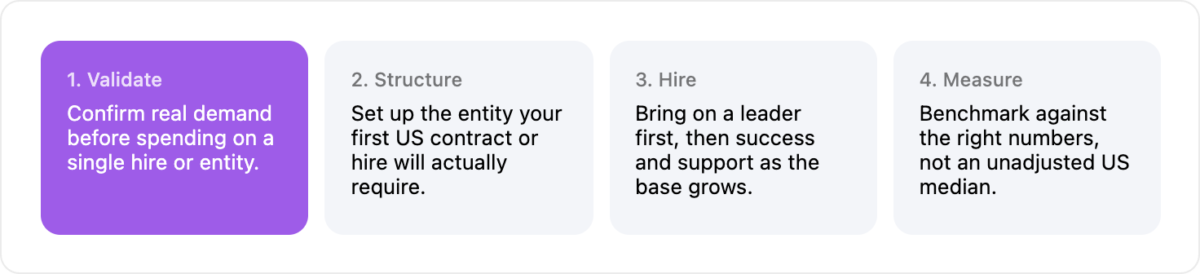
None of these five pieces work well in isolation. Validating demand tells you when to start spending. Getting the entity right means the first real contract doesn’t stall. Hiring a leader before a seller means the first 90 days build something repeatable instead of something anecdotal. Building support before volume forces it means your first US customers don’t have a worse experience than they’d get from a domestic competitor. And benchmarking against the right numbers means you can tell the difference between an expansion that’s working and one that just hasn’t failed loudly yet. Treat them as one sequence, not five separate decisions, and the US stops being a gamble and starts being a plan you can actually execute.

ABOUT THE AUTHOR
Written by Luca Lundgren, Founder at Demand Scalers. Luca has five years of demand generation experience working with companies like Simplex Wireless and Dentsu, and holds a Master’s in Marketing from Aalto University.