How ChatGPT Chooses Which B2B Brands to Recommend, and How to Get on the List
October 8, 2026
AI Overviews and B2B Traffic: How Much You Are Losing and What Content Survives
October 22, 2026

GEO vs SEO: What Changes When a European SaaS Enters the US
GEO vs SEO is the wrong fight for a small team. Google’s own guidance says optimizing for AI answers is still SEO. Yet ChatGPT, Perplexity and Copilot reward signals that Google rankings never measured. For a European SaaS entering the US, the useful question is which work serves both, what only GEO needs, and what from your home-market playbook to drop.
This article answers each part. If you are still shaping the wider entry plan, start with the US go-to-market playbook.
The Difference in One Line: A Position on the Page vs a Mention in the Answer
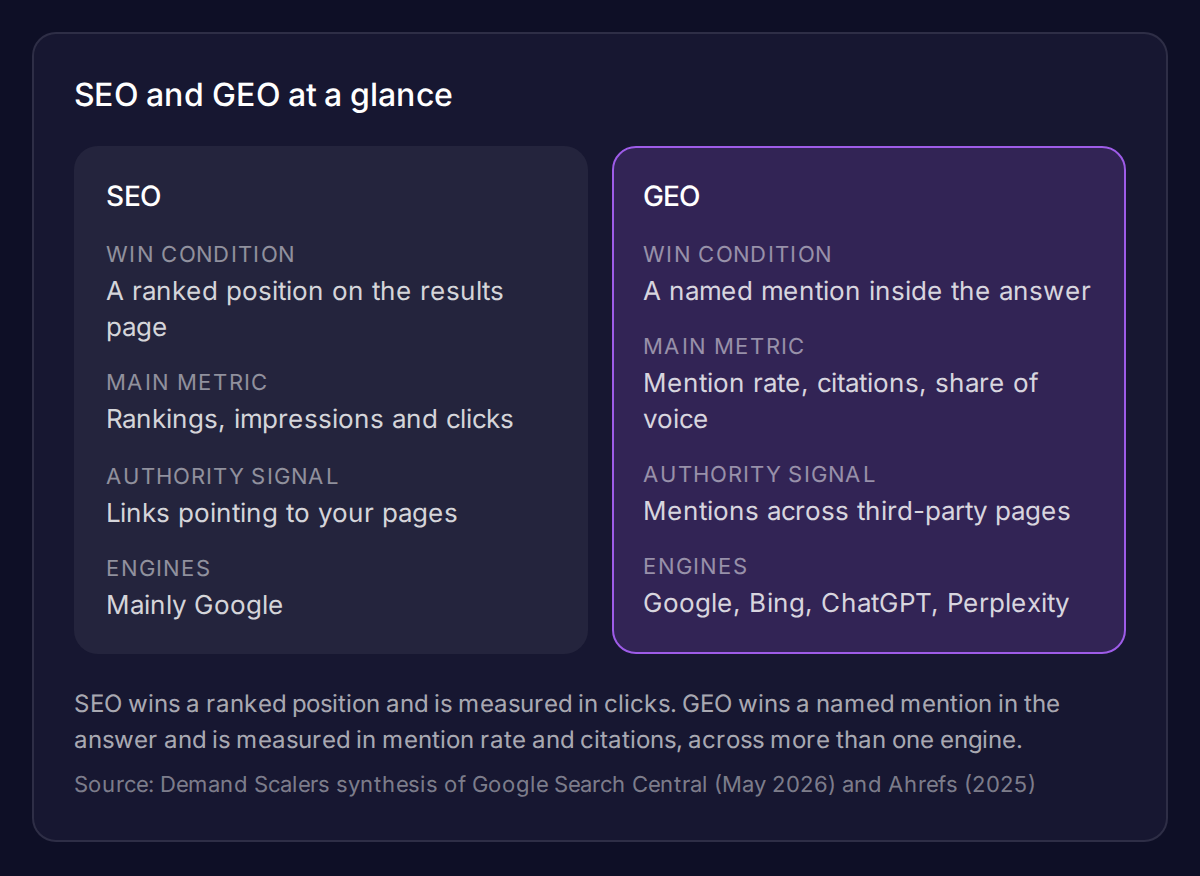
SEO earns a ranked position on a results page. GEO earns a named mention inside a generated answer. That single change moves the success metric, the signals that matter and the engines you need to appear in.
Clicks vs citations as the success metric
SEO reports run on impressions, rankings and clicks. The SEO vs GEO metrics that matter on the GEO side are mention rate (how often a prompt names you), citation rate (how often an answer links your pages) and share of voice against competitors.
You need both because clicks and influence are separating. Pew Research Center’s analysis of US browsing data, published in July 2025, found users clicked a standard result in 8% of visits when a Google AI summary appeared, against 15% when none did. A click-only report undercounts the buyers an answer already influenced. Keep your demand generation KPIs tied to pipeline and add the AI measures beside them.
GEO, AEO, AIO: which label to use, and why it barely matters
GEO (generative engine optimization) and AEO (answer engine optimization) describe overlapping work. AEO leans toward being the direct answer to a question. GEO leans toward being named and cited in a synthesized response. AIO usually abbreviates Google’s AI Overviews.
In the AEO vs GEO debate the difference is emphasis, not method. Pick one label internally and define it by the metrics above. Google’s May 2026 guide for generative AI search treats this work as part of SEO, so the label changes nothing about what you do on Monday.
What They Share: Why Good SEO Is Still the Foundation
Is GEO replacing SEO? Not according to Google. Its documentation says there are no additional requirements to appear in AI Overviews or AI Mode, and that existing SEO fundamentals keep applying. In practice the same holds beyond Google, because a page that cannot be crawled or indexed cannot be retrieved by any engine.
Crawling, indexing and technical health
To be shown as a supporting link in AI Overviews or AI Mode, Google says a page must be indexed and eligible to appear in Search with a snippet. Nothing more is asked on the technical side.
So your first audit is plain SEO. Confirm your English pages are indexed, that no nosnippet directive hides them, and that Googlebot, Bingbot and OAI-SearchBot can all fetch them. For a European team this often fails at the language layer: an automatic redirect by browser language can keep crawlers from ever reaching the English version.
Topical authority and internal linking
Google lists internal links among the fundamentals that still apply. Coverage of its May 2026 guide also notes that AI answers draw on organic results, including the follow-up queries the system runs. Ranking for the sub-questions around your category therefore feeds the answer.
Build one cluster per product use case, with internal links between the pages. This shared work is where a small team should spend its first hours.
Where They Split: Mentions, Third Parties and Bing
Backlinks vs brand mentions
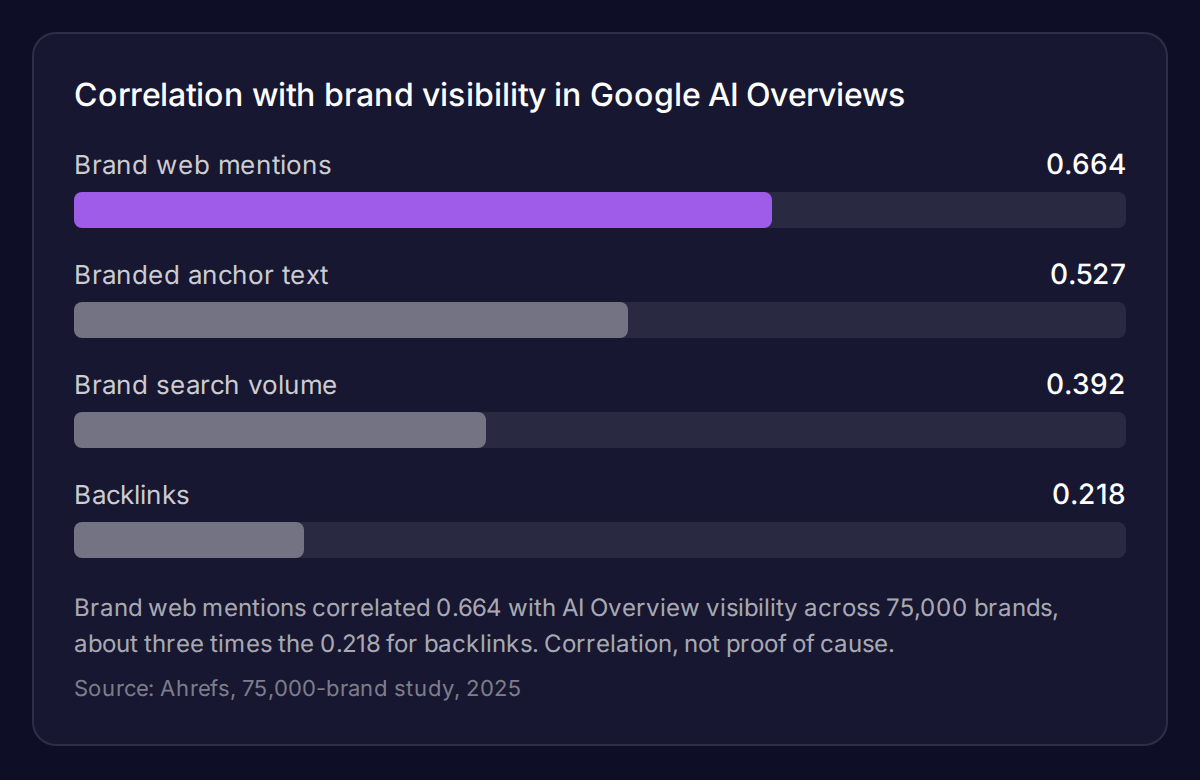
The sharpest data on brand mentions vs backlinks comes from Ahrefs’ study of 75,000 brands. It found brand web mentions correlated at 0.664 with visibility in Google AI Overviews, against 0.218 for backlinks. Ahrefs states plainly that correlation is not causation. Its December 2025 follow-up added ChatGPT and Google AI Mode, and YouTube mentions came out highest at roughly 0.737.
Read it as a second route to visibility, not a verdict on links. Links still help you rank, and ranking still feeds retrieval. But a US brand with many independent mentions in its category has an advantage that links alone do not create. Earn those mentions through reviews, communities and trade press. Coverage of Google’s guide says it warns against seeking inauthentic ones.
Optimizing for Bing as well as Google
Bing SEO matters more for GEO than it ever did for classic SEO. OpenAI documents that ChatGPT search can draw on third-party search providers, and Microsoft’s Copilot answers are built on Bing. A page invisible to Bing is a page that part of the AI layer cannot cite.
Bing also gives you something Google does not: first-party AI citation data. Microsoft launched AI Performance in Bing Webmaster Tools on February 10, 2026, as a public preview. It reports how often Copilot, AI summaries in Bing and select partner integrations cite your pages. If you only run Google Search Console today, do three things this week: verify your site in Bing Webmaster Tools, submit your sitemap and enable IndexNow so Bing learns about new pages quickly.
The European Mistake: Copying the SEO That Worked in Europe
European SEO success rests on a home-market footprint: a country-code domain such as .es, .de or .fr, local-language links and local buyer vocabulary. In the US, each of those works against you.
A native English site vs a translation with hreflang
Hreflang for an English site is the first thing most teams reach for, and it is necessary but not sufficient. Google’s guidance says to use separate URLs for each language version and hreflang annotations so searchers land on the right one. It also describes a country-code domain as a clear geotargeting signal, which tells Google your site is for that one country.
So an English site on a European country-code domain sends mixed signals. A .com or an /en-us/ subdirectory, paired with hreflang to your local-language pages, is cleaner. Avoid redirecting visitors by IP or browser language, since Google warns that can stop users and crawlers from seeing every version.
Hreflang only labels pages. It does not make them native. A literal translation of a local-language page carries your home market’s category phrasing, euro pricing and European examples. Rewrite for US buyers instead: USD prices, US customer references and the terms US buyers type. Our guide to positioning and messaging for the US market covers how.
Competing with US incumbents on the same queries
Translating your top-of-funnel posts, such as “what is [category]”, puts you against US incumbents with years of links and mentions. AI summaries also absorb many of those clicks, as the Pew data shows.
Pick queries where a newcomer can be named instead. “[Competitor] alternatives,” “[category] for [US-specific constraint],” integration pages for the US tools buyers already run, and a clear pricing page. These are the prompts buyers type when they are building a shortlist, so they serve rankings and AI answers at once.
How to Split Budget Between SEO and GEO With a Two-Person Team
Treat this as a starting point, not a benchmark. I know of no study that tests budget splits. For two people in the first quarter, I would divide weekly hours roughly 40% shared foundation, 40% bottom-of-funnel content and 20% third-party presence.
The reasoning is simple. Foundation is the prerequisite for both disciplines. Bottom-of-funnel content serves rankings and AI shortlists together. Third-party presence is the lever only GEO rewards, so it gets less time until the first two exist.
What content to stop producing
Stop three things. First, translated top-of-funnel explainers that put you against US incumbents. Second, “AI-friendly” rewrites such as cutting pages into tiny chunks, which coverage of Google’s guide says is not required. Third, mass-produced posts with no original data or point of view.
Fewer, original pieces serve both SEO and GEO better than volume does.
What to prioritize in the first quarter
In month one, make the English pages indexable and native, set up Bing Webmaster Tools and IndexNow, and check robots.txt and CDN rules for crawler blocks. In month two, publish five comparison or alternatives pages and a US-dollar pricing page. In month three, collect your first G2 or Capterra reviews from US customers, aim for two or three trade-press or community mentions, and start a monthly log of 20 buyer prompts alongside Bing’s AI Performance report.
If you want a team to run this, see our SEO and GEO service.