
GEO vs SEO: What Changes When a European SaaS Enters the US
October 15, 2026
How to Track ChatGPT and Perplexity Traffic in GA4, and Tie It to Demos
October 29, 2026
AI Overviews and B2B Traffic: How Much You Are Losing and What Content Survives
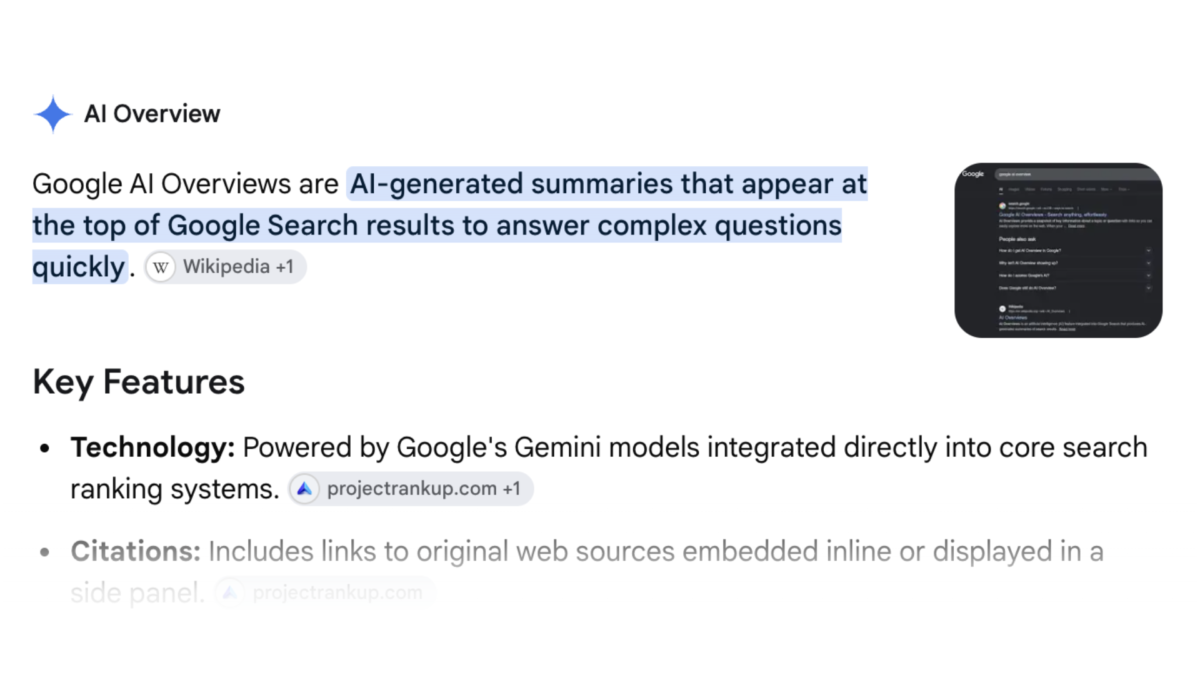
When an AI Overview appears, organic clicks fall by roughly 60% on informational queries. For a B2B SaaS, the number that matters is smaller: how many demos that traffic produced. For a European company entering the US there is a third question. You may have no US baseline to lose, so the real task is choosing which US queries to build for.
This article gives you the CTR data, a method to turn lost clicks into lost demos, and the content types that keep earning clicks.
What the Data Says About CTR When an AI Overview Appears
The AI Overviews CTR gap is large and well documented for informational queries. Seer Interactive’s September 2025 study tracked 3,119 informational queries across 42 organizations from June 2024 to September 2025. Organic CTR on queries with an AI Overview fell from 1.76% to 0.61%, a 61% drop. Queries without one sat at 1.62%, down 41% year on year.
Clicks are falling everywhere. The gap between the two groups is where AI Overviews do the damage.
Informational queries vs branded queries
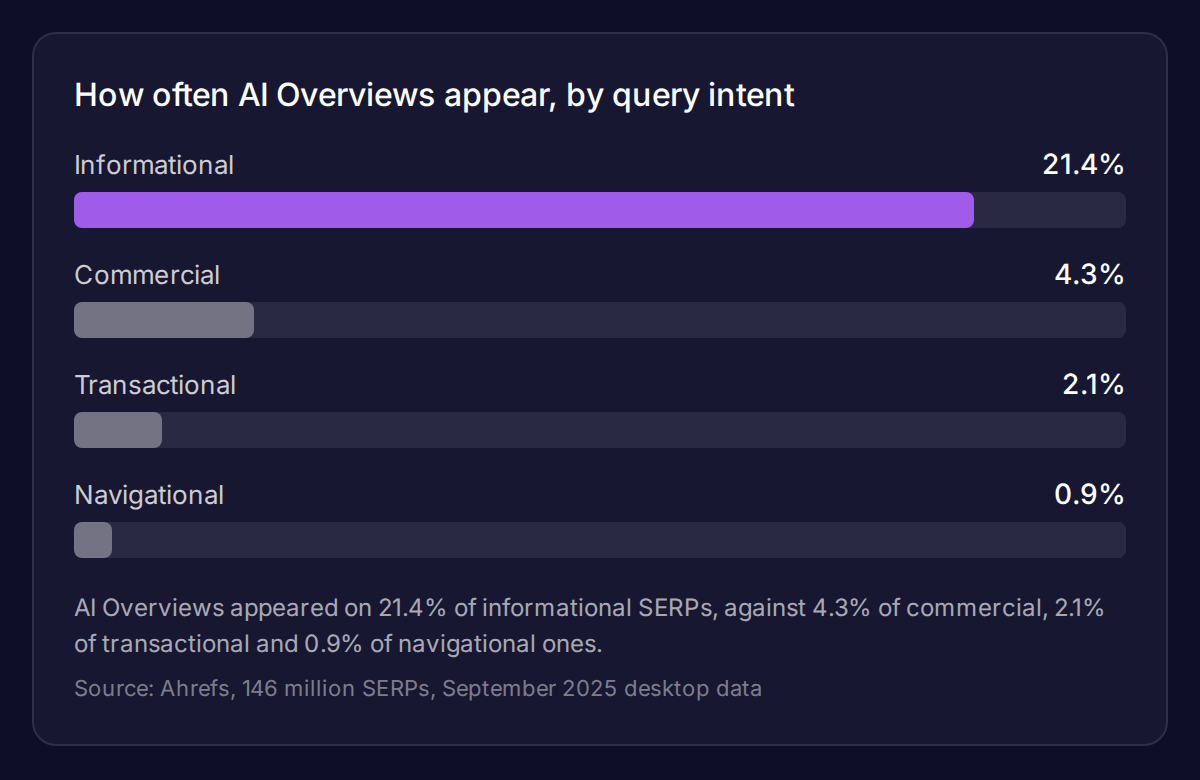
Exposure depends on the query type. In Ahrefs’ analysis of 146 million SERPs (September 2025 desktop data, published November 2025), AI Overviews appeared on 20.5% of SERPs overall. They appeared on 21.4% of informational SERPs, 4.3% of commercial ones, 2.1% of transactional ones and 0.9% of navigational ones.
Branded queries were also safer. AI Overviews showed on 13.1% of branded queries against 24.9% of non-branded ones. People who already know your name mostly still click your name.
Why B2B SaaS loses more than ecommerce
AI Overviews in B2B SaaS hit harder than in ecommerce because of what each side earns traffic from. In Ahrefs’ category data, Shopping triggered AI Overviews on 3.2% of SERPs. Computers and Electronics reached 28.6% and Internet and Telecom 30.3%.
Those labels are Ahrefs’ general categories, not B2B SaaS, so treat them as a direction. The reasoning is simple. A SaaS blog earns most of its traffic from “what is” and “how to” queries, which is exactly where AI Overviews appear. A store earns traffic from product queries, where they mostly do not.
One more caveat from the same Seer data: cited brands got 0.70% organic CTR against 0.52% for uncited ones in Q3 2025. Seer notes that stronger brands may simply be cited more often, so the citation itself may not cause the lift.
Traffic Is Not Pipeline: Calculate Your Real Exposure
Organic traffic decline from AI is real, but it lands on the traffic that usually converts worst. Your exposure in demos can be far smaller than your exposure in clicks. Work out which one you have before you change the content plan. Keep the result next to your demand generation KPIs so the decision is made on pipeline.
Split informational and commercial queries in Search Console
Google’s documentation (updated December 2025) says AI Overviews and AI Mode are counted in the Performance report inside the “Web” search type. It describes no separate AI-only view. So you split exposure by query pattern, not by feature.
In the Google Search Console AI Overviews view, which is the standard Performance report, filter Country to United States and Search type to Web. Add a query filter set to “Custom (regex)”. Run these two in turn and note clicks and impressions for each:
- Informational:
^(what|how|why|when|can|does|is|are|should)\b - Commercial:
\b(best|vs|alternative|alternatives|pricing|compare|comparison|review|reviews|software|tool)\b
The share of your clicks that comes from the first pattern is your exposure.
Turn a CTR drop into lost demos
Use this formula: impressions on informational queries, times the CTR gap, times your visit-to-demo rate. Here is a worked example with illustrative numbers. Take 50,000 monthly impressions. At 1.62% CTR that is about 810 clicks. At 0.61% it is about 305. The gap is roughly 505 clicks.
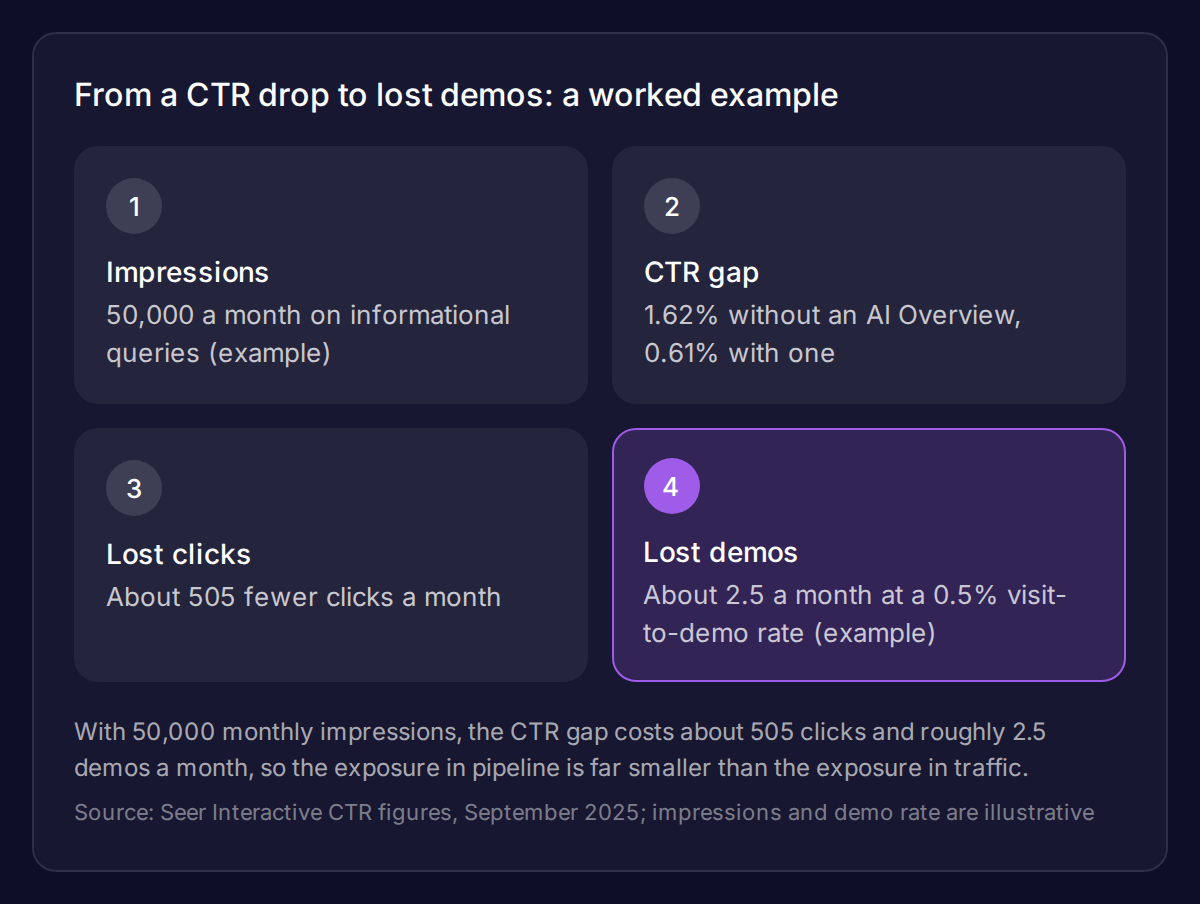
Replace both example inputs with your own. Then check in GA4 how many closed deals had a blog page earlier in the path. Informational traffic often influences deals without being the last click, and that influence is the part you cannot see in a CTR report.
Measure the Right Market: The US SERP vs the European SERP
A European brand has a measurement trap. Your own Search Console data describes your home market. A company entering the US may have almost no US clicks to lose, so the question is which US queries are worth building for. Our guide to validating US demand covers that step before you commit budget.
Check English-language results from a US location
None of the studies above is specific to a European brand entering the US, and I could not confirm the country split of their samples. Check your own queries instead. List 20 informational and 20 commercial queries your US buyer would type. Run each in English from a US location, using a US-located rank tracker or a clean browser profile with a US VPN.
For each query, record whether an AI Overview appears, whether you are cited and who is. Repeat monthly. A pattern across 40 queries tells you more than any average from another market.
Why your European Search Console data won’t transfer
AI Overview availability and frequency differ by country and language, so exposure measured on your European queries says little about US exposure. Query behavior differs too, so your top European queries may not be the ones US buyers search.
Filter Search Console to the United States and use that as your baseline. If it is nearly empty, that is the finding: you are building from zero, not defending traffic.
The Content That Still Earns Clicks
Zero-click searches in B2B concentrate on definitions and short answers. In Ahrefs’ query-type data, AI Overviews appeared on 47.3% of definition queries and 41.2% of short-fact queries. They appeared on 35.1% of instruction queries and 26.2% of comparison queries.
Comparisons are not immune, but they are the least exposed of the common types. They also match the moment a buyer is building a shortlist.
Comparisons, alternatives and pricing
Build pages for “[competitor] alternatives,” “[your product] vs [competitor]” and pricing. Commercial intent triggered AI Overviews on 4.3% of SERPs in Ahrefs’ data, against 21.4% for informational. Base them on real buyer constraints such as company size, stack, compliance and US-dollar pricing, so the page does something a summary cannot.
Tools, templates and original research
A summary can describe a calculator, but it cannot be one. Interactive tools, templates and checklists give the reader a reason to click through. Original data gives AI Overviews something to cite. Our US vs Europe SaaS benchmarks are an example of the kind of first-party reference page this means. This is reasoning from how the features work, not a measured result.
How to Get Cited Inside the AI Overview
Google says there are no extra requirements to appear in AI Overviews or AI Mode. A page must be indexed and eligible to show with a snippet. There is no special schema to add. How to get cited in AI Overviews therefore comes down to being the best answer to the sub-questions the system searches for. Google notes that AI Overviews and AI Mode may run several related searches, which it calls query fan-out, before building a response.
Extractable answers at the top of every section
Open each section with a one- or two-sentence direct answer, then add the detail. A system building an answer from several searches can lift a clean answer more easily than one buried in a paragraph. Write the heading as the question a buyer would ask and answer it immediately. This article follows that structure.
First-party data worth citing
Publish numbers only you hold: benchmarks from your customers, results from a test you ran, a survey with a stated sample. State the method and the date next to each figure. Cited brands in Seer’s data earned more clicks, though the study cannot prove the citation caused it, and original data is one of the few assets a new US entrant can create without years of backlinks.