

Attribution for AI-Driven SaaS Ad Campaigns: Measuring the Invisible
September 24, 2026
AI Ad Creative Tools for SaaS: A Buyer’s Guide
Google’s Performance Max and Meta’s Advantage+ have both automated targeting to the point where the algorithm decides who sees your ads and when. What’s left for a marketing team to actually control is the creative itself, and that’s exactly where AI tooling has moved next. A wave of platforms now generate, score, and test ad creative faster than any manual workflow, and for a lean European SaaS team running US campaigns without a large design team, that shift matters more than another targeting tweak.
Why the bottleneck isn’t bidding anymore, it’s creative
Automated bidding needs creative variety to actually test within, which is a problem when a small team can only hand-produce a handful of variants a month. The platforms below exist specifically to close that gap: generating dozens of testable variants from a single brief instead of one designer working through a queue.
Two categories: all-in-one platforms vs. specialized tools
All-in-one platforms (creative + campaign)
Some platforms take you from a product URL to a live, testable campaign without switching tools, generating creative, launching it, and pulling performance data back in automatically. This suits a team that wants one system handling the whole loop rather than stitching creative and campaign management together manually.
Specialized tools by format
Others focus on one part of the job well: a video-specific generator with a prediction engine trained on outcome data, an accessible general-purpose tool for small teams without a design background, or a platform built specifically for multivariate testing rigor rather than raw output volume. Picking a specialized stack means more integration work, but often a sharper result in the area that matters most to your team.
Predictive scoring: testing before you spend budget
The genuinely useful part of most of these platforms is scoring generated creative before any budget goes against it, so testing spend concentrates on the variants most likely to work rather than spreading thin across everything a brief produced.

According to one platform review that spent 60-plus hours testing these tools head to head, one leading prediction engine claims to forecast ad performance within 10 percent accuracy before launch, built on a database of over a million past ad outcomes. Treat any predictive score as a prioritization signal, not a guarantee, and validate it once against a set of your own past creatives with known outcomes before trusting it on new spend.
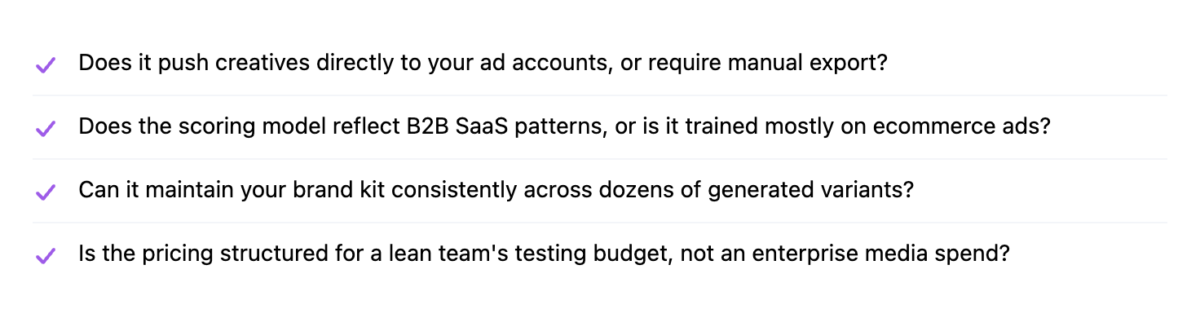
What to look for before choosing a tool with a European SaaS budget
How this fits with Performance Max and Advantage+
Neither PMax nor Advantage+ can optimize past the creative you feed them. Both platforms need enough creative variety to actually run a meaningful test, which is exactly what these tools are built to supply. Treat AI-generated creative as the fuel for the automated bidding you’re already running, not a separate initiative, and report on the same cost per SQL discipline either way, since a cheap creative that generates unqualified clicks is no better than an expensive one that doesn’t.
Common mistakes: creative volume without a testing strategy
The most common failure mode is generating dozens of variants and running all of them at once with no structured comparison, which just spreads a limited budget thinner without producing a clear winner. A second, subtler risk: predictive scoring models push every advertiser in a category toward the same “safe” high-scoring look, and if every SaaS competitor optimizes for the same score, distinctiveness, one of the strongest actual drivers of ad recall, quietly disappears. Use the score to prioritize what to test first, not as the final word on what to run.
None of this changes the sequencing in the US market entry playbook: creative tooling is an efficiency layer on top of a channel mix that already has to prove demand first, not a shortcut around doing that work. And budget expectations should match the US vs Europe cost benchmarks already established for this cluster, since a creative tool subscription is a small line relative to the media spend it’s meant to make more efficient.

ABOUT THE AUTHOR
Written by Luca Lundgren, Founder at Demand Scalers. Luca has five years of demand generation experience working with companies like Simplex Wireless and Dentsu, and holds a Master’s in Marketing from Aalto University.