
US vs. Europe SaaS Benchmarks: CAC, ACV, and Sales Cycle Length
April 15, 2026
How to Scale Your US Customer Base as a European SaaS Company
June 15, 2026

Building a US Customer Success Model as a European SaaS Company
Support becomes non-negotiable the moment your first US customers sign, not once volume justifies a team. Research consistently shows that 76% of customers would go out of their way to switch to a company known for outstanding support — which means a bad first support experience with your handful of US logos costs you more than the ticket it fixes.
Why support gets critical the moment US customers arrive
The most expensive mistake here is time zone coverage nobody planned for. A US customer who files a ticket at 9am Eastern and waits until your Amsterdam or Madrid office opens has already had a worse experience than they’d get from a US-based competitor, regardless of how good your product is. That gap compounds fast if it’s not addressed early, which is why it belongs in the same conversation as your broader US market entry KPIs — a support gap shows up in your retention numbers before it shows up anywhere else.
Reactive support or proactive customer success — what to build first
These are genuinely different jobs, and conflating them is a common early mistake.
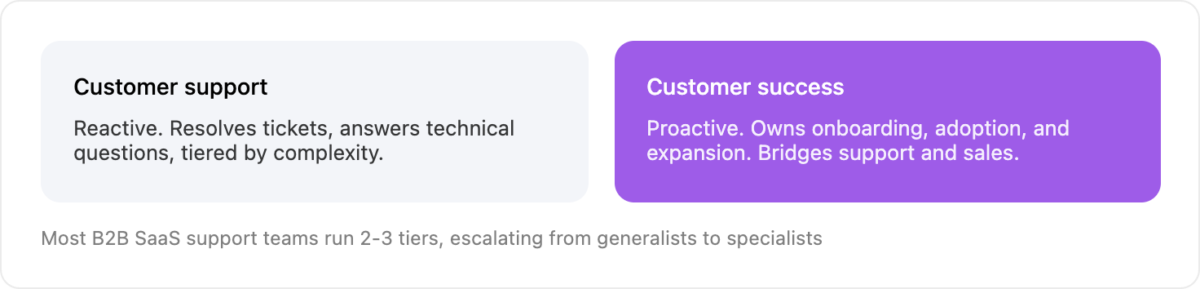
For most companies at the stage of hiring their first few US customers, you need support before you need a dedicated success function — the success role earns its place once there’s a base worth expanding, not before.
Models to cover the US without building a full team on day one
You don’t need a full in-house US team to give US customers a good experience. The hybrid model that works in practice: outsource Tier 1 to a trained BPO partner for coverage and volume, keep Tier 2 and escalations in-house with people who actually know the product, and let the capacity that frees up go toward proactive customer success work instead of firefighting. Round-the-clock coverage isn’t a luxury add-on here — companies offering 24/7 support see meaningfully higher retention, since a subscription business loses far more to slow silent churn than to any single bad ticket.
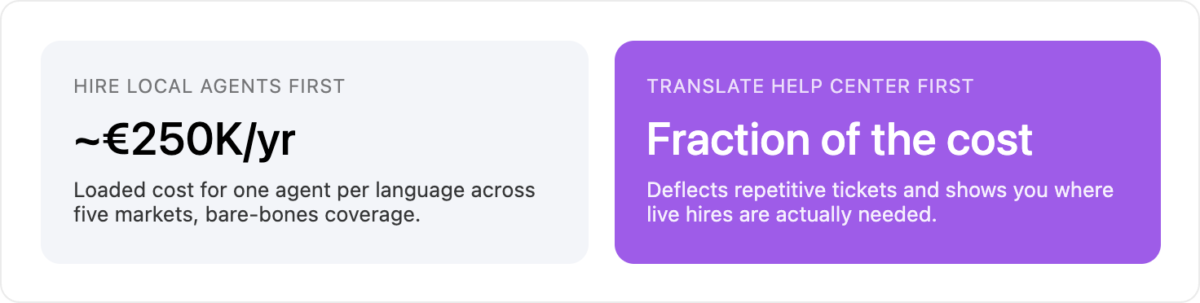
Language is the other lever, and it’s cheaper to solve than most founders assume. Before committing to headcount, a synced, translated help center deflects the bulk of repetitive tickets across languages at a fraction of the cost of hiring. According to a 2026 guide to scaling support for European expansion, hiring even one agent per language across five European languages approaches a quarter of a million euros a year in loaded cost — bare-bones coverage that still struggles during peaks. The same logic runs in reverse for a European company scaling into the US: build self-service first, watch where tickets and traffic actually concentrate, then hire against evidence rather than instinct.
Hiring your first US Customer Success Manager
Bring on a dedicated CSM once there’s a base of US accounts worth expanding, not before — their job is proactive outreach, onboarding, and expansion, not answering the same three tickets your help center could already deflect. They typically report into whoever owns revenue for the US, since retention and expansion revenue are directly tied to the pricing and packaging decisions you’ve already made for the US market — a CSM who doesn’t understand why the pricing works can’t defend it in a renewal conversation.
Culture matters more than it looks on a hiring scorecard. Peer recognition programs and flexible scheduling have been shown to cut agent attrition by as much as 30% at scale, and high turnover on a young support team shows up directly in customer-facing quality before it shows up on a P&L.
Metrics that show your support is ready to scale
Track first-response time and resolution time by tier, deflection rate on your self-service content, and — most importantly — whether support tickets correlate with expansion or with churn. If your best-supported accounts are also your best-retained accounts, the model is working. If our own services or customer stories can help you think through where your team sits on that curve, that’s exactly the kind of conversation worth having before the first bad US ticket becomes a lost renewal.
ABOUT THE AUTHOR
Written by Luca Lundgren, Founder at Demand Scalers. Luca has five years of demand generation experience working with companies like Simplex Wireless and Dentsu, and holds a Master’s in Marketing from Aalto University.