
ChatGPT Ads for SaaS: What European Teams Need to Know
July 15, 2026
Meta Advantage+ for B2B SaaS: When It Works and When It Doesn’t
September 15, 2026

Google Performance Max for B2B SaaS: A Guide to Not Burning Your Budget
Google keeps pushing Performance Max harder every quarter, and for a European SaaS team new to the US market, that pressure is easy to mistake for an endorsement. It isn’t one. PMax was built for ecommerce, where every conversion is a purchase and more conversions are unambiguously good. B2B SaaS doesn’t work that way, and the gap between those two models is where most first-time PMax budgets in the US disappear.
What Performance Max is and why Google keeps pushing it
Performance Max is a single automated campaign type that spans Search, Display, YouTube, Gmail, Discover, and Maps. You set a conversion goal and a budget; the algorithm decides where, when, and to whom to show ads across that entire inventory. For ecommerce, that’s genuinely useful: a purchase is a purchase no matter which surface produced it. For B2B SaaS, it means the algorithm is free to spend across channels your sales team has no relationship to, optimizing toward whatever conversion event you fed it, whether or not that event has anything to do with revenue.
The “feedback loop of doom”
Left unguarded, PMax defaults to the cheapest available conversion. In a B2B SaaS account that conversion is almost always a form fill, and the algorithm has no way to know that most of those form fills are the wrong prospect. It just sees a completed action and asks for more of them.
What conversion you’re actually feeding the algorithm
If your only conversion signal is “form submitted,” PMax will chase form submissions, full stop. It cannot distinguish a VP evaluating your product from a student researching a class project, because both completed the same tracked action. The fix isn’t a better bid strategy; it’s a better signal, which means offline conversion data flowing back from your CRM so the algorithm learns from qualified pipeline, not raw form fills.
Minimum conversion volume for the algorithm to learn
PMax also needs enough conversion volume per week to find a pattern at all. Below that threshold, the algorithm is guessing, and a guessing algorithm with a live budget is exactly how spend disappears without producing pipeline.
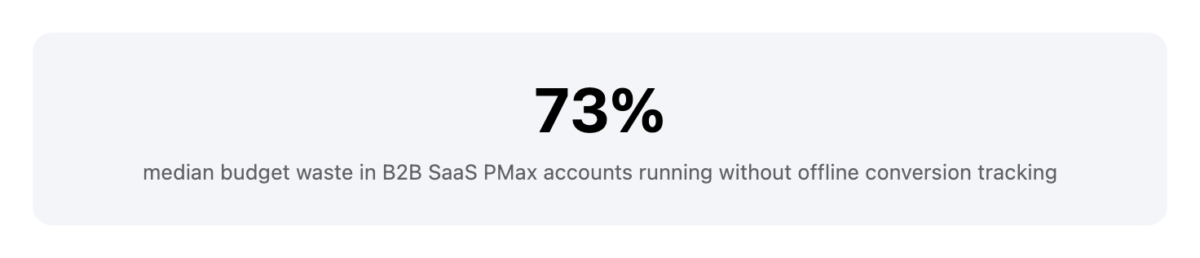
According to one detailed 2026 breakdown of PMax setups across dozens of B2B SaaS accounts, unguarded accounts without CRM-connected conversion tracking waste a median of 73 percent of spend this way, and accounts need roughly 50 or more conversions a week before the algorithm has enough signal to optimize reliably. Below that volume, treat PMax as a controlled experiment, not a channel you can trust with real budget yet.
AI Max for Search: the safer way to start
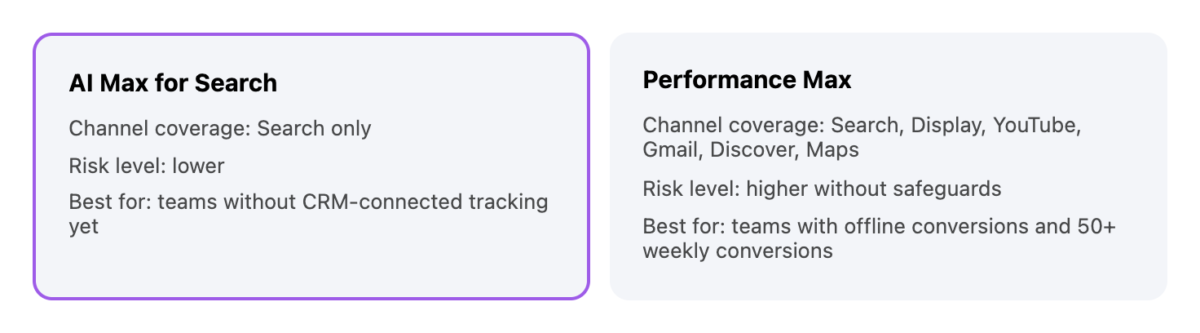
If the conversion volume or CRM integration isn’t ready, AI Max for Search is the lower-risk entry point. It expands your existing Search campaigns to catch long-tail and conversational queries you aren’t currently bidding on, but it stays on the Search network only, no Display, YouTube, or Gmail inventory to lose budget into. For a team that wants the query-expansion benefit of PMax without handing the algorithm the entire Google ad inventory on day one, this is the safer first move.
What to have in place before activating PMax
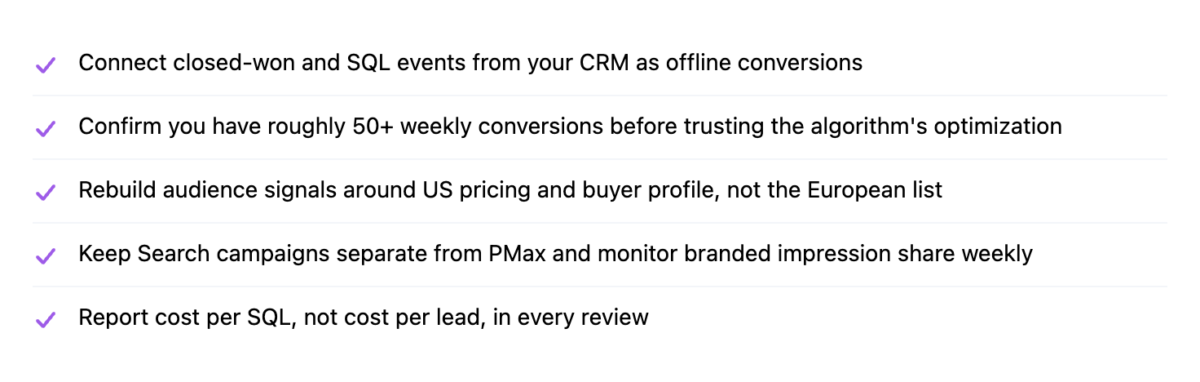
Offline conversions connected to your CRM
Before turning PMax on, connect closed-won and sales-qualified-lead events from your CRM back into Google Ads as offline conversions. This is the single change that lets the algorithm optimize toward pipeline instead of form fills, and it’s the difference between the 15 to 25 percent improvement in cost per qualified lead that well-instrumented accounts see and the budget waste that unguarded ones absorb.
Audience signals from your European ICP, adapted for the US
Audience signals you upload (customer lists, in-market segments, competitor terms) are suggestions, not restrictions. PMax will serve outside them if it finds conversions there anyway. Still worth uploading, because they tell the algorithm where to start looking, but a European customer list built for a different buyer and a different price point needs to be rebuilt around your US vs Europe SaaS benchmarks before it’s a useful seed for US targeting.
How to structure campaigns by funnel stage
Don’t run PMax as your entire paid media strategy. Segment by funnel stage instead: intent-based Search campaigns for buyers already searching, PMax layered in only for supplemental reach once the fundamentals above are in place, and a clear separation between the two so PMax can’t cannibalize the branded search traffic your Search campaigns already convert efficiently. Watch impression share on branded terms after launch; a drop signals PMax is taking credit for conversions your Search campaigns would have won anyway.
The metrics that actually matter
Cost per lead is close to meaningless in B2B SaaS, since it treats every form fill as equally valuable. Cost per SQL is the number to report, because it’s the one metric that survives contact with your actual pipeline. This is the same discipline covered in the demand generation KPI framework for US market entry: track branded search lift and demo requests from a consistent segment before trusting any in-platform number, and treat your own first quarter of US data as the baseline rather than importing someone else’s benchmark.
Risks: brand cannibalization and budget waste
The two failure modes worth naming plainly: PMax quietly eating your branded search traffic and getting credited for conversions you’d have won anyway, and PMax spending against a cheap, unqualified conversion event because nobody told it not to. Both are avoidable, and both require the same fix, closing the loop between ad spend and actual pipeline data before you scale budget.
5-step launch checklist
None of this replaces the sequencing already laid out in the US market entry playbook: prove demand before scaling spend, and treat channel sequencing as deliberate, not simultaneous. PMax is a supplement to that sequence once the prerequisites above are met, never the first channel you turn on.

ABOUT THE AUTHOR
Written by Luca Lundgren, Founder at Demand Scalers. Luca has five years of demand generation experience working with companies like Simplex Wireless and Dentsu, and holds a Master’s in Marketing from Aalto University.