

Google Performance Max for B2B SaaS: A Guide to Not Burning Your Budget
August 15, 2026
LinkedIn Ads in the US vs. Europe: Why Your CPC Triples
September 22, 2026
Meta Advantage+ for B2B SaaS: When It Works and When It Doesn’t
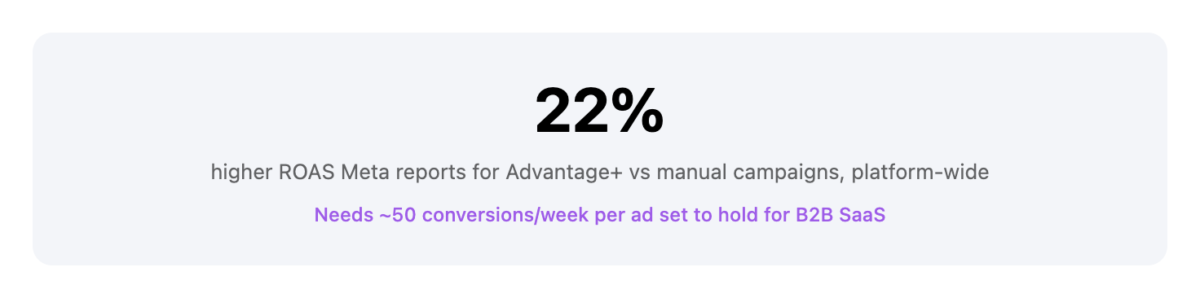
Meta’s own data shows Advantage+ campaigns delivering 22 percent better ROAS than manual campaigns. That number gets repeated everywhere, and it’s real, but it’s an average pulled from an inventory dominated by ecommerce and high-volume B2C accounts. B2B SaaS sits in a different part of that average, and treating the headline number as your expected outcome is how teams end up disappointed with a platform that can genuinely work, just not the way the pitch implies.
What Advantage+ promises, and the fine print behind the 22% figure
Advantage+ automates targeting, creative combinations, and budget allocation across Meta’s entire placement inventory using a single algorithm. That’s the same trade-off PMax makes on Google: you hand over granular control in exchange for the algorithm finding patterns you couldn’t find manually. The catch is identical too. The algorithm needs enough optimization events to find a pattern in the first place, and B2B SaaS lead volume rarely gets there.
The conversion threshold most B2B SaaS teams never reach
Advantage+ needs roughly 50 conversion events per week per ad set to exit the learning phase reliably. A B2B SaaS company generating 20 to 30 qualified leads a week from Meta, a solid number by B2B standards, still sits below the volume the algorithm needs to learn efficiently. Below that threshold, Advantage+ isn’t optimizing so much as guessing with your budget attached to it.
This is the same instrumentation problem covered in the demand generation KPI framework: a channel’s reported number and its actual contribution to pipeline are two different things, and the gap gets wider the more automated the channel is.
CPQL, not CPL: the metric that decides if it’s worth it
Cost per lead tells you nothing about whether Advantage+ is working, because a cheaper lead that never converts is worse than an expensive one that does. Cost per qualified lead is the number that actually settles the question, and it’s the only one worth reporting to anyone deciding whether to keep the budget line. Run this discipline from day one rather than retrofitting it once a quarter of unqualified volume has already been spent.
Seeding the algorithm with CRM-based lookalike audiences
Advantage+ still benefits from good seed data even though it targets broadly by default. Building lookalike audiences from your closed-won accounts, not just anyone who filled out a form, gives the algorithm a much sharper starting point than an unseeded broad campaign. Pair this with LTV-based bidding if your CRM can pass deal value back to Meta; it works best for subscription businesses with a clear pattern of repeat revenue, which describes most SaaS pricing models directly.
Creative first: the biggest lever in B2B Meta ads
Targeting automation only helps if the algorithm has enough creative variety to test within it. This is where most B2B accounts underinvest relative to ecommerce advertisers, who routinely run dozens of creative variants at once. Five to ten distinct creatives per campaign is a reasonable floor, refreshed before frequency climbs too high and performance decays.
Meta vs LinkedIn when European CPC benchmarks don’t translate
A European SaaS team used to LinkedIn’s European cost structure will find neither Meta nor LinkedIn behaves the same way in the US. Meta’s B2B cold-prospecting leads tend to run more expensive and lower quality than a well-targeted LinkedIn campaign, but Meta pulls ahead on retargeting and lookalike-based prospecting once you have closed-won data to seed it with. Neither replaces the other; the US vs Europe SaaS benchmarks on CAC make clear that budgeting for both channels at European cost assumptions is the fastest way to run out of runway before either one has enough data to perform.
Test plan: manual first, Advantage+ second
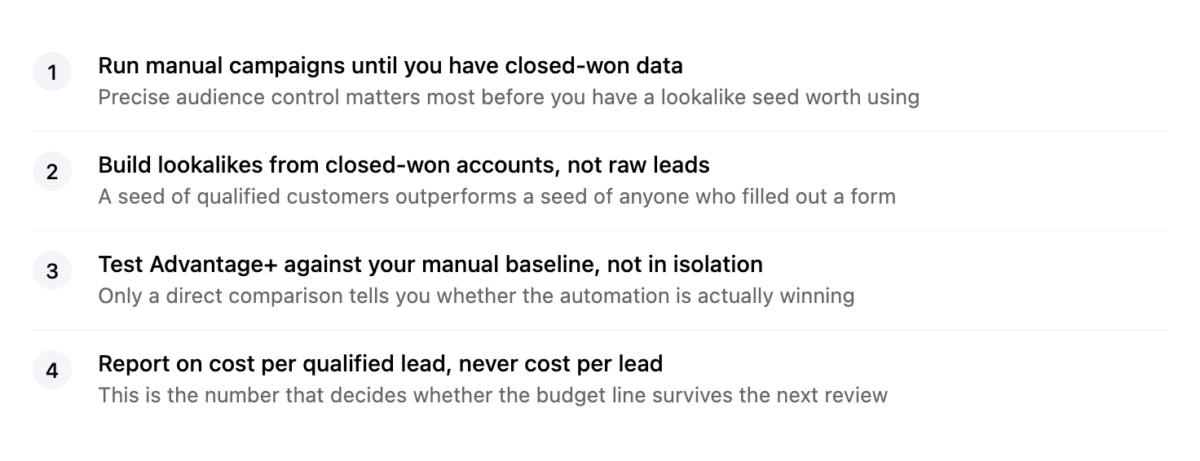
None of this changes the sequencing already set out in the US market entry playbook: Meta is a supplement once outbound and paid search have proven demand, not a channel to lead with, and it belongs in the same channel mix discipline as everything else in your US paid budget.

ABOUT THE AUTHOR
Written by Luca Lundgren, Founder at Demand Scalers. Luca has five years of demand generation experience working with companies like Simplex Wireless and Dentsu, and holds a Master’s in Marketing from Aalto University.